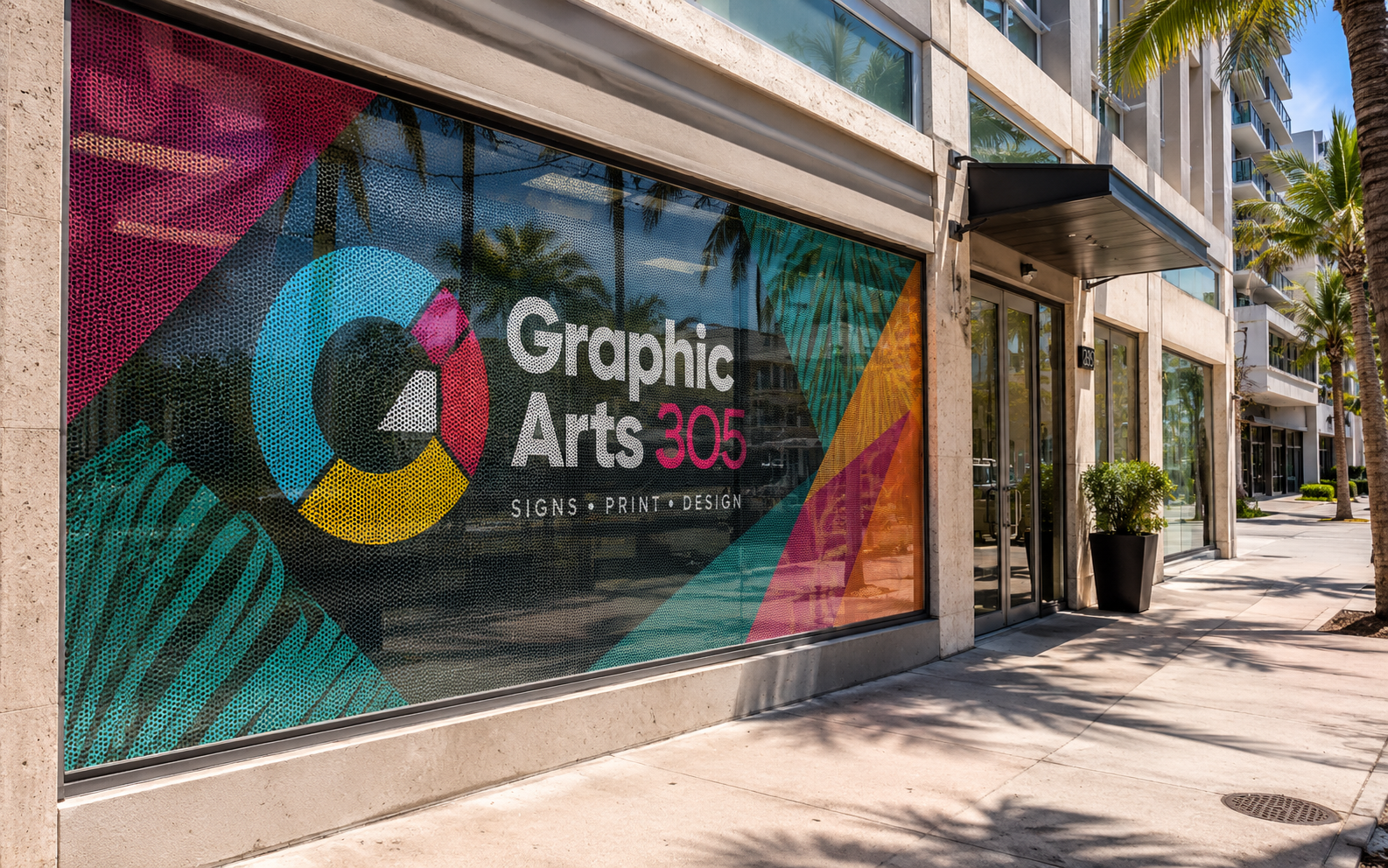
Perforated window vinyl Miami solutions allow businesses to transform ordinary glass into advertising space without completely losing outward visibility. A professionally designed window graphic can promote your brand, improve privacy, strengthen your storefront and make better use of surfaces you already have.
This guide explains how perforated vinyl works, when it makes sense, how it compares with other window materials and what businesses should consider before ordering. If you are evaluating window signs, a window decal, a full storefront window treatment or other graphics in Miami, the information below will help you choose a solution based on function rather than appearance alone.
Article Outline
- What Is Perforated Window Vinyl and How Does It Work?
- Why Use a Window Graphic on a Miami Storefront?
- Does Perforated Window Film Really Provide One Way Vision?
- Which Businesses Benefit Most From Storefront Window Graphics?
- Perforated Vinyl vs. Solid Vinyl, Window Cling and Frost
- How Should a Custom Window Graphic Be Designed?
- Can Window Vinyl Be Used on Commercial Vehicles?
- What Affects the Durability of Vinyl Printing in Miami?
- Professional Window Graphic Installations vs. DIY Application
- How to Choose the Right Perforated Window Vinyl for Your Business
What Is Perforated Window Vinyl and How Does It Work?
A perforated window graphic is produced using adhesive material containing thousands of small holes across the printed surface. Those openings allow people positioned behind the glass to see through much of the material while the exterior presents a printed image, message or branded design.
The principle is relatively simple. Instead of covering the entire glass surface with solid vinyl, the printer uses a perforated material that combines printed areas and open space. From the outside, the eye tends to concentrate on the printed graphic. From the inside, the openings improve visibility toward the street.
This type of window vinyl is commonly used for advertising campaigns, retail promotions, office privacy and vehicle applications. The material can carry photography, logos, contact information or promotional messages, allowing a company to perforate large sections of glass visually without creating the completely blocked effect associated with opaque film.
Why Use a Window Graphic on a Miami Storefront?
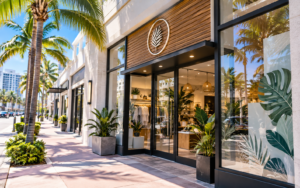
Commercial glass is valuable marketing space. A plain storefront may expose the interior, but it often does little to tell potential customers what the company offers. Adding a professionally designed window graphic changes that relationship.
A business can use its windows to communicate its brand, highlight products and make the location easier to recognize. This is particularly useful in areas where customers make decisions while walking or driving past. Strong storefront branding can communicate before a person reads a website, scans a QR code or walks through the door.
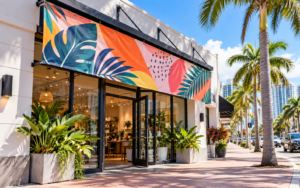
For many storefronts, the advantage is also economical: the advertising surface already exists. Instead of installing a separate banner or relying exclusively on other forms of signage, businesses can use their own glass. A well-planned miami window treatment can turn unused space into an advertising asset while still maintaining some connection between the interior and exterior.
Does Perforated Window Film Really Provide One Way Vision?
The terms one-way, one way vision and one-way vision film are commonly associated with perforated graphics, but they need to be understood correctly.
A perforated window treatment can create an effect where people outside primarily see the printed image while people inside maintain a degree of outward visibility. This happens because the darker interior-facing portion and the small openings in the film affect how the eye perceives the surface.
However, a see-through effect is influenced by lighting. If the exterior is brighter than the interior, the printed graphic usually appears stronger from outside. At night, when interior lighting becomes brighter than exterior conditions, the effect can be reduced.
For that reason, businesses seeking absolute privacy should not assume that perforated window films behave like a wall. If privacy is the main objective, other materials may be more appropriate, or the project may require a combination of solutions.
Which Businesses Benefit Most From Storefront Window Graphics?
Different businesses use a window decal for different reasons. A restaurant may want stronger food imagery. A fitness center might need large lifestyle photography. A medical practice may be more concerned with reducing direct views into treatment areas.
Retail locations can use storefront window graphics to promote products, seasonal campaigns or special events. Service companies can explain what they offer before potential customers enter. Offices can improve privacy while displaying their identity in a professional way.
A custom window treatment can also help businesses operating in shopping centers, street-level locations and high-traffic commercial areas. In Miami-Dade, where businesses frequently compete for attention across busy streets and retail corridors, glass can serve as part of a larger exterior communication system.
The key is to choose the right type of window graphic for the objective. A promotional campaign does not necessarily require the same material as permanent office privacy, and a retail display should not automatically use the same solution as a medical facility.
Perforated Vinyl vs. Solid Vinyl, Window Cling and Frost
Not every glass application should use perforated vinyl. Several window materials are available, and each behaves differently.
Solid vinyl provides more complete visual coverage. It is useful when the goal is to hide the interior, display stronger colors or create an opaque surface. Cut vinyl and vinyl lettering are better suited to business hours, logos, names and relatively simple information.
A window cling may work for short-term or removable campaigns, while frost film is often selected for offices, meeting rooms and areas where privacy matters more than full-color advertising. Etched glass effects can produce a more architectural appearance without using large photographic designs.
A vinyl window application therefore should not be chosen simply because one material appears more attractive. The decision depends on whether the business needs privacy, outward visibility, permanent branding, promotional flexibility or decorative treatment.
In some projects, mixing materials produces a better result than using only one. A storefront may combine a decal, printed sections, frosted zones and uncovered glass rather than covering every panel identically.
How Should a Custom Window Graphic Be Designed?
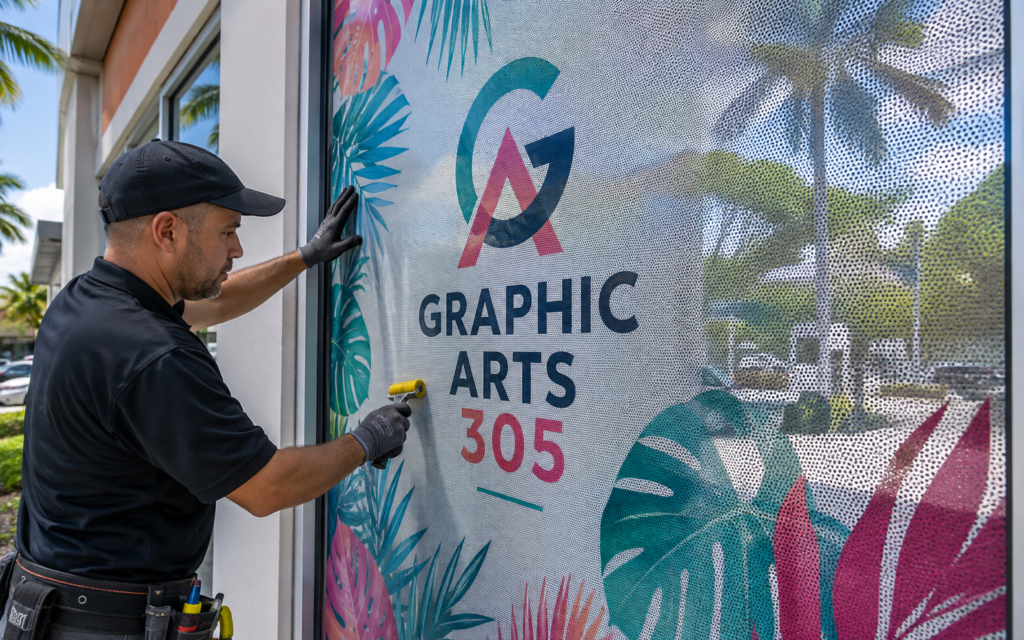
Successful large-format design requires a different approach from designing social media posts or printed flyers.
A storefront window may be seen from across a parking lot or from a moving vehicle. That means the primary message should be understood quickly. The visual hierarchy usually needs to prioritize the company name, key message, imagery and call to action.
An eye-catching design does not mean adding more elements. In many cases, reducing visual clutter creates more impact. Large typography, clear photography and controlled spacing tend to work better than trying to fit every service into one graphic.
Designers also need to account for doors, frames, handles and architectural breaks. A face, logo or important word can become difficult to read if it lands directly across a mullion.
For this reason, window graphic installations should begin with accurate measurements and an understanding of the actual space. Proper planning ensures that the finished decal feels integrated with the architecture instead of simply being applied on top of it.
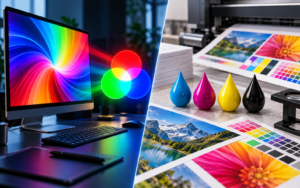
The quality of the source files is equally important. Large windows amplify poor resolution. High-quality photography and vector artwork help the final print remain sharp and professional at scale.
Can Window Vinyl Be Used on Commercial Vehicles?
Yes. Perforated materials are also used as part of commercial vehicle graphics.
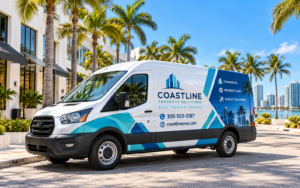
When a body wrap reaches a compatible window area, using a perforated product can allow the design to continue visually across the glass. This produces a more complete branded appearance than abruptly stopping the artwork at every window.
A vinyl wrap can therefore combine solid material on painted surfaces with perforated film on selected glass areas. Delivery vans, service vehicles and commercial fleets often benefit from this approach because additional surface area becomes available for communication.
However, vehicle applications require careful planning. Driver visibility and applicable local regulations should always be considered before placing material on automotive glass.
Professional window wraps should therefore balance branding with safe operation. A design that looks strong while parked should not interfere with how the vehicle must function on the road.
What Affects the Durability of Vinyl Printing in Miami?
Outdoor graphics in South Florida face demanding conditions. Heat, humidity, heavy rain and intense UV exposure all influence how printed materials age.
The lifespan of a window graphic depends on several factors, including material quality, adhesive type, orientation of the glass, installation conditions and exposure to direct sunlight. Two graphics installed on opposite sides of the same building may age differently because one receives substantially more sun.
Professional vinyl printing should therefore match the product to the expected environment instead of using one generic material for every project.
Lamination and finishing may also be considered depending on the application. The correct approach varies according to whether the project is a temporary campaign, a longer-term storefront installation or a vehicle application.
For businesses in Miami and surrounding areas, weather exposure is not a secondary consideration. The exterior graphic represents the company every day, so material selection needs to account for the conditions it will actually face.
Professional Window Graphic Installations vs. DIY Application
A small vinyl decal can sometimes be applied without professional installation. A multi-panel commercial project is different.
Large graphics require accurate alignment, clean surfaces and precise trimming. If an image continues from one glass panel to another, even a small positioning error becomes visible. Poor installation can create lifting edges, wrinkles or inconsistent spacing.
Professional installers also understand how to work around frames, doors and complex storefront layouts. This becomes especially important when several pieces need to combine into a single composition.
DIY installation can appear less expensive initially, but errors may require reprinting material. For large business windows, professional installation is often the safer choice when presentation and durability matter.
Companies comparing suppliers should therefore evaluate more than print price. Design preparation, material selection, installation experience and overall printing services all contribute to the final result.
How to Choose the Right Perforated Window Vinyl for Your Business
Start by defining the problem the glass needs to solve.
Do you want more privacy? More advertising? Stronger branding? Better recognition from the street? A temporary promotion? A full redesign of the exterior?
The answer determines whether you need perforated window decals, solid material, lettering, frosted film or another approach.
Next, think about viewing distance and available space. A small window decal near an entrance can contain more detailed information than a large roadside graphic. A design intended for moving traffic should be much simpler.
The same principle applies when comparing a window installation with a banner, vinyl banners or conventional signs. Each format communicates differently and should be selected according to where and how people will see it.
Businesses should also review the provider’s experience with commercial printing and installation. Companies such as Signarama and other established sign providers illustrate how broad the market for professional glass graphics has become, but the right supplier should understand your exact application rather than simply recommend the most common material.
At Graphic Arts 305, businesses can combine design, large-format production and commercial graphic solutions within a broader visual branding strategy. Whether the project involves a single decal, a complete storefront, vehicle branding or miami window graphics, the objective should remain the same: use the available surface intelligently.
Perforated Window Vinyl in Miami: Make Your Glass Work Harder
Commercial windows do not have to remain passive architectural surfaces.
With the right graphic, they can communicate your services, strengthen your brand, add privacy and help potential customers understand your business before entering.
For companies considering perforated window vinyl, the most important decision is not simply what image to print. It is determining how the window needs to function, how customers will view it and which material produces the correct balance between advertising and visibility.
Graphic Arts 305 provides professional graphic production and commercial printing solutions for businesses throughout the area. From a simple decal to complete storefront treatments, the right strategy can transform ordinary glass into useful marketing space.
Key Things to Remember
- Perforated window vinyl combines printed advertising with partial outward visibility.
- A perforated window graphic works best when design, lighting and viewing distance are considered together.
- One-way visibility is influenced by lighting and should not be confused with guaranteed privacy.
- Solid vinyl, frost film and perforated products solve different problems.
- Large storefront designs should prioritize readability instead of excessive information.
- Accurate measurements are essential before producing large-format graphics.
- Outdoor conditions in South Florida should influence material selection.
- Professional installation reduces the risk of alignment, trimming and adhesion problems.
- Vehicle glass can sometimes be incorporated into a commercial wrap using compatible perforated materials.
- Graphic Arts 305 can help businesses turn existing glass surfaces into functional branded advertising.