A strong event brand does more than place a logo on a wall. It turns a venue into a recognizable environment, connects every attendee touchpoint, reinforces your message, and helps people remember the experience long after the event is over.
Whether you are planning a conference, trade show, product launch, networking experience, or corporate event, thoughtful branding can make the difference between an event that simply looks organized and one that genuinely strengthens your brand.
This guide explores practical event branding ideas, visual systems, signage, environmental graphics, experiential concepts, and production strategies you can use to create a cohesive and memorable experience.
Article Outline
- What makes a strong event brand?
- Why does corporate event branding matter?
- How can event branding resonate with attendees?
- Which signage and environmental graphics work best?
- How should experiential branding shape the event experience?
- What makes event branding projects feel cohesive?
- How can branding work across physical and digital touchpoints?
- What should you consider for an outdoor event?
- Which event items should carry the brand identity?
- How can you build a stronger brand for your next event?
What Makes a Strong Event Brand?
A successful event brand begins with more than a logo. It needs a complete visual identity capable of working across multiple formats, environments, sizes, and communication channels.
The foundation normally includes the event logo, colors, typography, graphic patterns, photography direction, messaging style, and supporting design elements. Together, these create an event identity that attendees can recognize whether they are looking at the entrance, their badge, a presentation screen, the event website, or a social post.
Consistency is essential. When every visual component feels disconnected, the event loses part of its professional impact. When the same visual language appears seamlessly across the entire experience, the brand becomes easier to recognize and remember.
This does not mean every surface must look identical. A strong brand system should be flexible enough to adapt to different applications while maintaining a cohesive personality.
For example, a stage background can use bold graphics, while a directional sign may be much simpler. Both can still clearly belong to the same brand.
Why Does Corporate Event Branding Matter?
Corporate event branding is especially important because the event often represents the company in a highly concentrated environment.
For a few hours or several days, customers, partners, employees, prospects, media, and suppliers are experiencing the organization through a physical space. Every graphic, surface, sign, presentation, and interaction contributes to their perception of the brand.
Strong corporate branding helps communicate professionalism and consistency. It also gives companies an opportunity to translate their everyday identity into something more dynamic and experiential.
A corporate event may include:
- Conferences
- Product launches
- Trade shows
- Sales meetings
- Employee events
- Networking events
- Award ceremonies
- Brand activations
The best corporate event branding ideas do not simply repeat the corporate logo everywhere. They adapt the existing identity to the specific objective, audience, and event theme.
A company launching a new technology product, for instance, may develop a more futuristic visual system while still maintaining recognizable colors and typography from the master brand.
This balance helps reinforce brand awareness while giving the event its own personality.
How Can Event Branding Resonate With Attendees?
Good branding should be visually attractive, but appearance alone is not enough.
For branding to resonate, it needs to reflect the audience, the message, and the purpose of the event.
Consider what the attendee should feel.
Should the environment feel premium? Innovative? Playful? Exclusive? Educational? Energetic?
These decisions should influence everything from typography and photography to materials, lighting, graphics, and spatial design.
A financial conference may benefit from refined graphics and controlled typography. A creative festival may use illustrations and branding with more expressive compositions. A product activation may require a completely immersive environment.
Understanding your audience also improves the attendee experience.
For example, clear navigation reduces confusion. Well-positioned branding reinforces where people are. Branded social areas encourage networking. A striking installation can create a natural place for attendees to stop and take photos.
The goal is not simply to decorate the venue. It is to build a memorable experience around the brand.
That is what turns a visually polished event into an impactful event.
Which Signage and Environmental Graphics Work Best?
Physical graphics remain some of the most powerful tools for branding an event because they transform ordinary spaces quickly.
Effective signage serves two purposes: communication and branding.
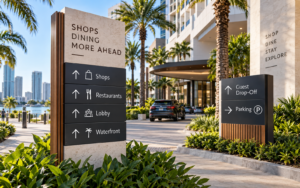
Directional signs help visitors move through the venue, while large-format graphics reinforce the visual identity. When both functions are combined properly, even practical information becomes part of the brand experience.
Useful solutions can include:
- Entrance graphics
- Directional signs
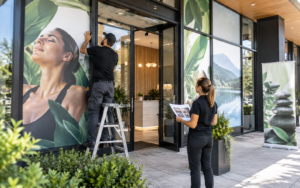
- Wall wraps
- Floor graphics
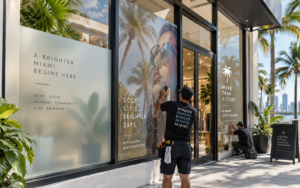
- Window graphics
- Backdrops
- Hanging graphics
- Branded counters
- Posters
- Foam board displays
- Fabric graphics
- Retractable displays
- A large-format banner
Branded signage should follow the same typography, colors, graphic style, and messaging hierarchy used throughout the event.
Large walls are especially valuable branding opportunities.
Instead of leaving them empty, temporary vinyl graphics can transform the event space into a communication platform. They can feature campaign imagery, sponsor information, product photography, illustrations, timelines, or large-scale brand messages.
Floor graphics can also help guide event attendees while introducing another layer of visual communication.
For businesses organizing events in Miami, Graphic Arts 305 can produce large-format graphics, wall wraps, floor graphics, banners, backdrops, window graphics, and custom event displays that help turn a standard venue into a branded environment.
How Can Experiential Branding Improve the Event Experience?
Modern event branding increasingly focuses on experiential design.
Instead of asking only, “What will attendees see?”, organizers should ask:
What will attendees experience?
This shift is important because physical interaction creates stronger memories.
An immersive installation can encourage visitors to explore. Interactive walls can invite participation. Product demonstrations can place the brand directly into the attendee’s hands.
Even relatively simple ideas can become experiential.
For example, photo booths can use custom backgrounds, dimensional branding, lighting, or themed props. A unique photo installation may encourage guests to create and share content organically.
This type of experience design connects physical branding with emotion and participation.
Environmental graphics also play an important role.
Environmental design considers how walls, floors, structures, furniture, lighting, displays, and wayfinding work together. Rather than placing individual signs throughout a room, the entire environment becomes part of the brand.
This approach can be especially effective for a custom event, where the goal is to create an environment attendees cannot easily confuse with another company or conference.
The most powerful branding becomes part of the experience rather than sitting on top of it.
What Makes Event Branding Projects Feel Cohesive?
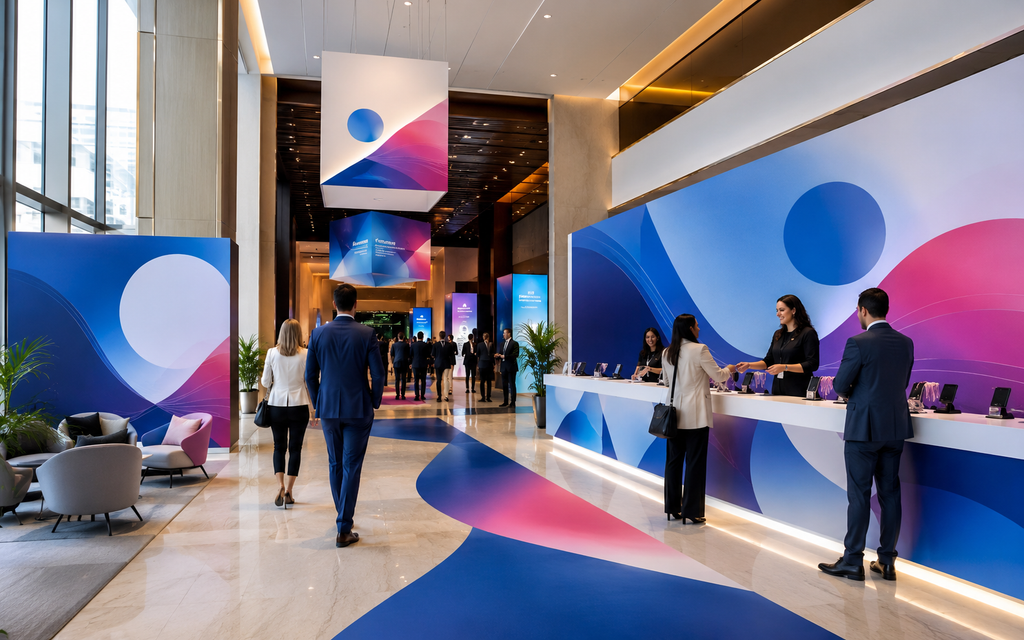
Many event branding projects fail for a simple reason: individual pieces are designed independently.
The stage looks one way.
The registration desk looks another way.
The email campaign uses different graphics.
The social content introduces additional colors.
By the time the attendee arrives, there is no clear visual system connecting everything.
A better event branding strategy begins before individual materials are created.
First establish:
- Core colors
- Typography
- Logo rules
- Photography direction
- Graphic patterns
- Icon style
- Messaging hierarchy
- Layout principles
These become the central branding elements that guide the entire project.
From there, designers can adapt the system to different formats without losing consistency.
A small name tag cannot use the same composition as a 20-foot stage background, but both should clearly belong to the same brand.
This consistency is one of the foundations of effective event branding.
It also simplifies production because designers, printers, event staff, sponsors, and other teams are working from the same visual framework.
Strong guidelines therefore improve both creative quality and event management.
How Should Branding Work Across Physical and Digital Touchpoints?
Today, an event rarely begins at the venue.
The first touchpoint may happen weeks earlier through an email, online ad, invitation, or social media post.
That means pre-event communication should already introduce the visual system attendees will later experience in person.
The event website, event page, registration emails, social graphics, and marketing campaigns should use the same colors, messaging, typography, and photography direction.
This creates continuity.
When attendees arrive and see those same elements on walls, signs, displays, badges, and screens, the physical environment feels familiar.
Digital tools can reinforce this consistency.
An event app can use the event’s graphics and navigation style. Social content can feature the same campaign imagery. QR codes placed on physical materials can connect guests with digital schedules, registration pages, product information, or downloadable resources.
These digital touchpoints also extend the event beyond the physical venue.
Attendees may continue interacting with the brand through social media platforms after the event, particularly if the physical environment encouraged them to create and share content.
Successful branding therefore connects online and offline experiences rather than treating them as separate projects.
What Should You Consider When Branding an Outdoor Event?
An outdoor event introduces challenges that do not exist in a controlled indoor environment.
Graphics need to compete with larger spaces, changing lighting conditions, weather, movement, and greater viewing distances.
Scale becomes especially important.
A design that works perfectly on a monitor may disappear when placed across a large outdoor venue.
Visibility should therefore guide your visual design decisions.
Large logos, strong contrast, clear typography, and simplified messaging usually work better than complicated layouts.
Material selection also becomes critical.
Outdoor graphics may require weather-resistant substrates, durable inks, secure installation systems, and materials suited to wind, sunlight, humidity, or temporary exposure.
Wayfinding can also become more important because attendees may travel longer distances between different areas.
Strategically placed signs, entrance graphics, flags, floor or ground graphics, and large-format displays can help maintain a clear event identity across the venue.
A successful outdoor brand environment combines visibility, durability, and consistency.
Which Event Items Should Carry the Brand Identity?
Small details matter because attendees often interact with them more closely than with large graphics.
Useful event items can include:
- A badge
- Name badges
- Printed schedules
- Programs
- Cards
- Folders
- Product packaging
- Promotional materials
- Table graphics
- Stickers
- Staff credentials
A professionally designed badge, for example, does more than display a name. It can reinforce colors, typography, sponsorships, access levels, and event identity.
The same applies to name badges for event staff.
These small objects contribute to the overall visual system.
Not every item needs a large logo. Often, subtle use of typography, color, patterns, or icons creates a more sophisticated result.
The objective is consistency.
When even the smallest materials feel connected to larger signs, stage graphics, and digital assets, the branding becomes more convincing.
These details also strengthen the event’s branding because attendees experience them repeatedly throughout the day.
How Can Stage Design Strengthen the Brand?
The stage is one of the highest-value areas of any conference or corporate gathering.
It is visible to nearly every attendee and appears repeatedly in event photography, speaker videos, livestreams, presentations, and social posts.
That makes stage design a strategic branding tool.
A strong stage may combine:
- Large-format graphics
- Fabric backdrops
- Dimensional logos
- Screens
- Lighting
- Branded podiums
- Side panels
- Sponsor graphics
Logo positioning requires particular attention.
A logo placed too low may disappear behind speakers or furniture. One placed too far toward the edges may not appear in close-up photographs.
Designers should therefore think not only about the audience inside the venue, but also about how the stage will appear through a camera.
This is especially valuable because the content created during the event may continue circulating months afterward.
A well-designed stage can therefore extend the life of your event marketing beyond the actual event date.
How Can You Create a Stronger Brand for Your Next Event?
The strongest branding ideas for events begin with strategy rather than production.
Before choosing materials, establish what the event needs to communicate, who the audience is, and what actions attendees should take.
Then identify the areas with the greatest visual impact.
The entrance may deserve a larger investment because every attendee passes through it. A stage may be important because it appears constantly in video. A photo installation may generate organic social content.
This helps prioritize your branding efforts.
Avoid adding graphics simply because space is available.
Every element should have a purpose.
Ask:
Does it improve navigation?
Does it strengthen the visual identity?
Does it create an interaction?
Will it appear in photographs?
Does it support the event theme?
Will attendees remember it?
These questions make it easier to develop successful event branding rather than simply producing more materials.
For your next event, consider the complete journey from initial invitation to final departure.
A successful event feels connected at every stage.
When the logo, typography, environmental graphics, digital content, event materials, displays, staff identifiers, and physical installations all reinforce the same message, the brand becomes part of the experience itself.
Event Branding Production in Miami
Great concepts require equally strong production.
Poor resolution, weak materials, inaccurate colors, visible seams, or badly installed graphics can reduce the perceived quality of an otherwise strong creative concept.
Production should therefore be considered during the event planning process, not after the creative work is complete.
When hosting an event in Miami, working with a printing and graphics partner that understands large-format production can simplify the process.
Graphic Arts 305 produces a wide range of materials for brand events, including:
- Custom event backdrops
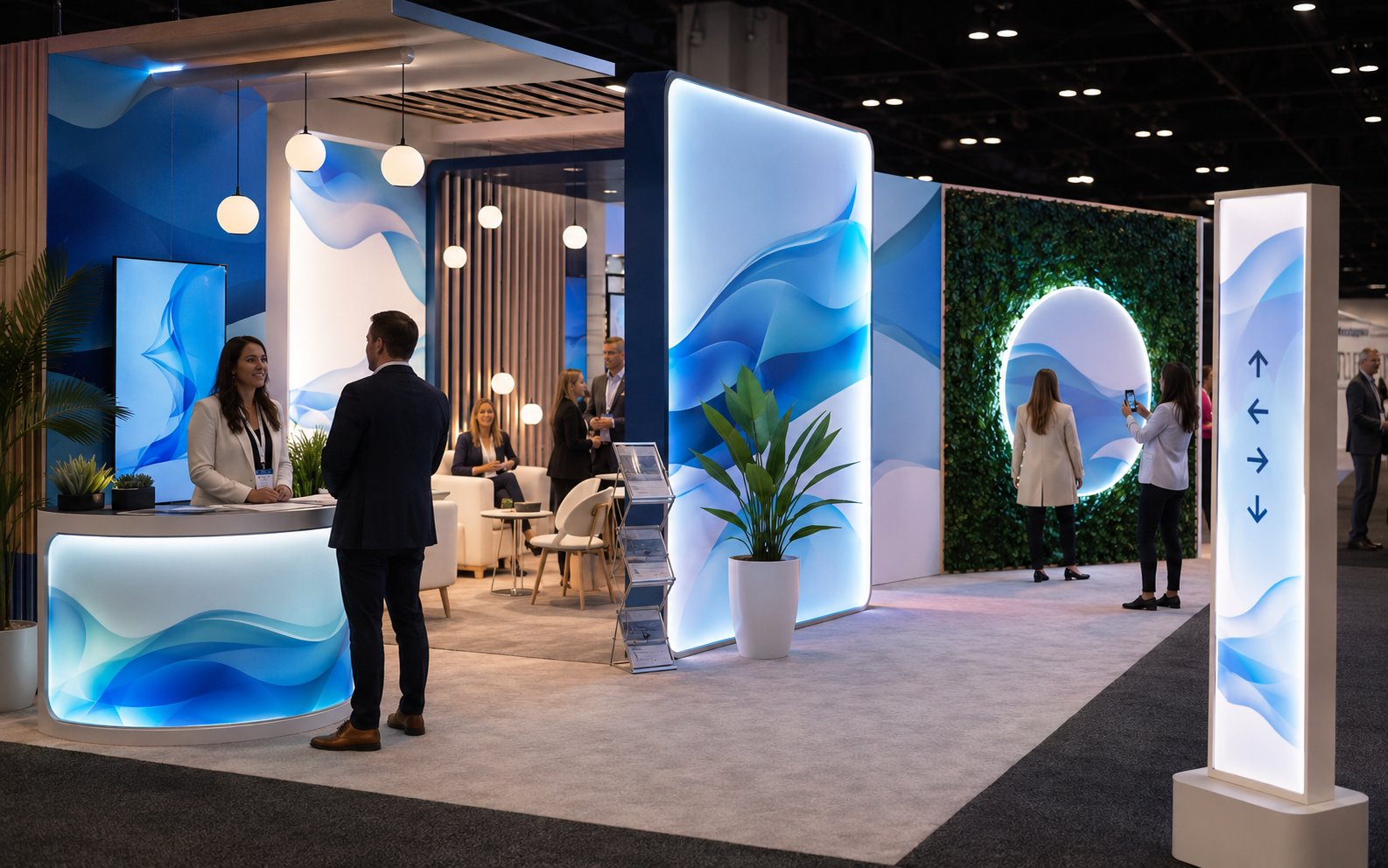
- Trade show displays
- Large-format graphics
- Wall wraps
- Floor graphics
- Window graphics
- Retractable banners
- Fabric printing
- Foam board graphics
- Custom signage
- Backlit displays
- Event graphics
These solutions allow companies to build cohesive physical environments without treating every application as an isolated project.
From an entrance wall to a conference stage or exhibition booth, professional production helps ensure that the final result accurately represents the intended brand identity.
Final Takeaways: Building a Memorable Event Brand
A memorable event is rarely created by one oversized logo or one impressive display. It comes from a system of connected decisions that work together throughout the attendee journey.
The most important things to remember are:
- Start with strategy. Define the audience, message, objective, and overall personality before designing individual materials.
- Build a complete brand system. Colors, typography, imagery, graphics, and messaging should work together.
- Think beyond the logo. Use environmental graphics, interactive areas, displays, lighting, and physical surfaces to create an immersive environment.
- Keep the experience cohesive. Digital communication, event materials, registration, stage graphics, and venue branding should feel connected.
- Design for attendees and cameras. Many visual elements will live beyond the event through photography, videos, and social content.
- Use signage strategically. Combine navigation and branding wherever possible.
- Choose production materials carefully. Scale, lighting, location, installation, and durability all affect the final result.
- Create interactions. Experiences that invite attendees to participate can leave a stronger lasting impression.
- Prioritize high-impact spaces. Entrances, stages, booths, registration areas, and photo installations usually offer the strongest visibility.
- Work with an experienced production partner. Professional printing and installation can turn creative concepts into a polished final environment.
Your event should not feel like a room filled with printed graphics. It should feel like your brand has temporarily become a physical place.
If you are planning a conference, trade show, launch, or branded experience in Miami, Graphic Arts 305 can help transform your creative concept into professional large-format graphics, custom signage, displays, backdrops, wall graphics, floor graphics, and event installations.
Get a free quote today!