When comparing a vinyl banner vs mesh banner, the right decision depends on more than price. Location, wind exposure, print detail, viewing distance, installation method, and size all influence performance. Both options can perform effectively, but they solve different problems.
This guide explains mesh vs vinyl banners for business promotions, construction fencing, storefronts, an outdoor event, and other commercial applications. You will learn the practical differences between vinyl and mesh banners, when each works best, and how to choose the right substrate for interior and exterior applications.
Article Outline
- Core differences between solid vinyl and mesh
- Print quality and visibility
- Outdoor performance and wind resistance
- Best use cases for vinyl
- When to choose mesh
- Size, finishing, and installation
- Pros and cons of each material
- Fabric alternatives
- Choosing the right option for Miami businesses
- Frequently asked questions
What Is the Difference Between a Vinyl Banner and a Mesh Banner?
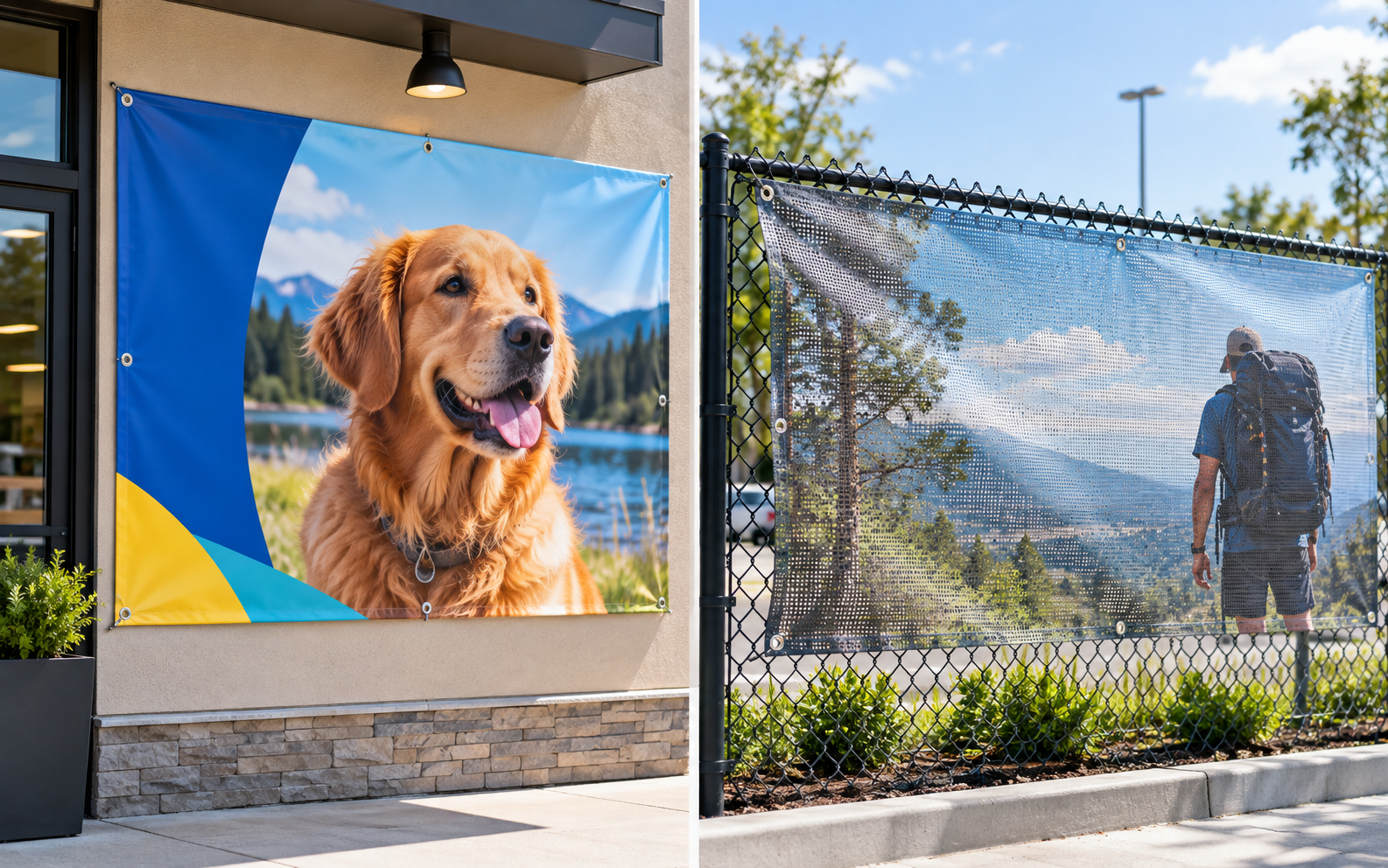
The biggest difference is the construction of the printable surface. A vinyl banner uses solid vinyl, typically a reinforced PVC material, creating a smooth face that accepts ink across nearly the entire area. This makes vinyl especially effective for detailed logos, photography, gradients, small typography, and saturated brand colors.
A mesh banner uses a perforated surface containing thousands of small openings. Those openings allow air to pass through instead of pressing against one continuous sheet. This mesh construction is useful for exposed exterior installations where airflow and wind resistance matter.
It is also worth clarifying a common misconception: mesh is not necessarily the opposite of vinyl. Many commercial mesh products are made from perforated vinyl-based material. In practical terms, the comparison is often solid vinyl versus perforated mesh vinyl. Understanding these differences between vinyl formats makes it easier to match the product to the application.
How Does the Material Affect Print Quality and Visibility?
The printable surface directly affects image reproduction. Solid vinyl gives a printer a continuous area for ink, so colors tend to appear more saturated and fine details remain easier to reproduce. This is useful when your design includes product photography, detailed branding, QR codes, fine lines, or smaller text.
With mesh, part of the surface consists of openings. Color density can therefore appear slightly lighter compared to vinyl. That does not mean mesh produces poor graphics. It means the artwork should be designed for the substrate: larger typography, fewer small details, strong contrast, and clear focal points.
Viewing distance matters too. A large mesh graphic on a construction fence may be seen from across a street, where tiny perforations are barely noticeable. A display viewed from only a few feet away may benefit more from a smooth surface. Matching artwork to the material is an important part of professional banner printing.
Which Banner Is Better Outdoors and in Windy Locations?
For outdoor use, the installation environment matters more than a simple vinyl vs mesh rule. A solid graphic mounted flat against a wall behaves differently from an oversized print stretched across an open fence where air can reach both sides.
Mesh banners for outdoor applications are popular because the perforations allow wind to pass through the surface. This reduces pressure on the material and its attachment points, which makes mesh better suited to windy locations, large fences, scaffolding, sports facilities, and open event spaces.
A vinyl banner outdoors can still be an excellent solution when properly specified. Storefront promotions, wall-mounted advertising, temporary commercial signage, and protected exterior areas frequently use solid vinyl. For South Florida, the correct choice should account for exposure, support structure, finishing, and overall size. Material matters, but installation conditions matter just as much.
When Is a Vinyl Banner the Right Banner?
Vinyl is often the right banner when visual impact is the highest priority. Its smooth surface makes it a strong choice for detailed graphics, photos, rich colors, logos, and promotional messages viewed at close or medium distance.
Typical use cases include retail promotions, storefront advertising, grand openings, real estate marketing, interior displays, temporary business signage, wall-mounted graphics, and trade show applications. In these environments, the extra airflow offered by mesh may provide little practical benefit.
Common commercial stock includes oz vinyl options such as a 13 oz vinyl banner, as well as heavier material depending on the job. Scrim vinyl is widely used because internal reinforcement helps improve strength and durability. A heavier material is not automatically better; finishing, support, duration, and exposure should also be considered.
This is why vinyl banners are the go-to for many promotional projects where opacity, sharp reproduction, and strong color are priorities.
When Should You Choose Mesh for a Construction Site or Fence Banner?
You should choose mesh when airflow becomes a major performance requirement. A construction site is a classic example because printed graphics are often attached to temporary perimeter fencing where wind can hit from both directions.
A mesh display can turn a fence into advertising space for project renderings, leasing information, contractor details, logos, phone numbers, or coming-soon messaging. Because the surface is perforated, it allows wind to pass rather than forcing all pressure against one large sheet.
This characteristic makes mesh practical for a fence banner, scaffolding, sports facilities, festivals, and other open structures. Mesh banners are designed to provide airflow while preserving a large branded surface.
The trade-off is opacity: bright backgrounds can be more visible through mesh, and very small details may lose impact. For oversized exterior graphics, however, that compromise is often worthwhile.
What Are the Main Use Cases for Vinyl vs Mesh Banners?
Different environments call for a different banner solution. Solid vinyl works particularly well for storefront promotions, retail campaigns, photo-heavy designs, real estate advertising, indoor displays, sales events, branded backdrops, and wall-mounted exterior promotions.
Mesh works best for exposed applications such as construction fencing, scaffolding, large perimeter barriers, festivals, sporting venues, parking areas, and other open installations. In these situations, mesh banners excel because the openings permit air to pass through the surface instead of building pressure behind the graphic.
The point of comparing vs mesh banners is not to decide that one product is universally superior. Ask what the display needs to accomplish: maximum visual detail or improved airflow? Close viewing or long-distance visibility? A wall installation or an open fence?
These questions make choosing the best material much easier. Vinyl and mesh both have a place in commercial signage because each solves a different physical and visual problem.
How Do Banner Size, Grommet Placement, and Installation Affect Durability?
Banner size changes the forces acting on an installation. A small graphic fixed to a solid wall does not behave like a 40-foot print attached to an exposed fence. As the size of the banner increases, wind load, edge reinforcement, hardware, and the supporting structure become more important.
A grommet provides a reinforced attachment point, but proper spacing matters. Hems, pole pockets, mounting hardware, tension, and the condition of the supporting surface also influence durability. A durable product installed poorly may fail sooner than a correctly specified one installed with appropriate support.
For open exterior locations, installers should evaluate whether air can reach the back surface. If it can, perforated material may reduce stress. If the graphic sits flat against a solid structure, solid vinyl may be suitable.
In other words, material affects performance, but it is only one part of the installation system. Dimensions, finishing, mounting, weather exposure, and maintenance all contribute to overall durability.
What Are the Pros and Cons of Each Material?
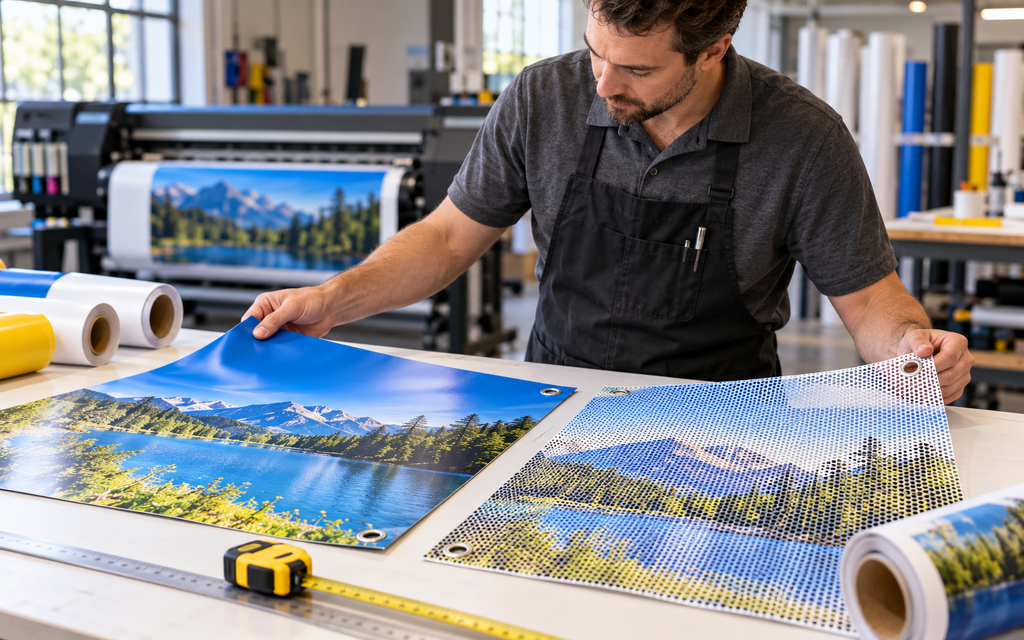
Looking at the pros and cons helps clarify the decision. Solid vinyl offers strong color saturation, excellent photo reproduction, high opacity, crisp typography, and versatility. It is especially effective where branding needs to look polished at close range.
Its main weakness is airflow. A large solid surface can catch more wind in an open location. That does not make vinyl unsuitable outside; it simply means the location must be evaluated correctly.
Mesh offers better airflow, lower wind pressure, and strong suitability for large exposed applications. It is often better suited to fences and scaffolding. The trade-off is a less dense printable surface, so fine typography and intricate artwork need more careful design.
The cons of each material are closely related to their strengths. Solid construction improves visual density but blocks airflow, while perforations improve airflow but reduce printable area. Choosing the right option means deciding which property matters most for the actual installation.
How Does Fabric Compare With Vinyl and Mesh?
Fabric banners serve a different purpose. They are often selected for interior environments where texture, portability, drape, or a premium textile appearance matters. Common examples include conferences, presentation spaces, branded backdrops, and selected display systems.
The comparison between vinyl and fabric is different from mesh versus solid vinyl. Fabric can offer a softer appearance, while vinyl is valued for strong graphics, easy cleaning, and versatile temporary signage. For an exposed exterior fence, however, fabric is usually not the most relevant alternative.
Banners can also be printed on specialized media for specific systems. A retractable banner, for example, may use material selected to roll smoothly inside its hardware rather than standard exterior stock.
The intended display system should always influence the final choice. This is why vinyl and fabric banners may be compared for an exhibition or interior promotional environment, while mesh versus vinyl is usually the more relevant question for exposed exterior installations.
How Do You Choose the Right Material for Your Business?
Choosing the right banner material starts with the installation rather than the printer’s substrate catalog. Determine whether the display is protected or windy, small or oversized, wall-mounted or open on both sides.
Then consider the artwork. Detailed photography and fine typography generally favor a smooth solid surface, while large headlines and simple branding can work extremely well on mesh. Viewing distance, installation duration, supporting structure, and whether the graphic needs to be moved or reused should also influence your decision.
Before ordering, ask:
- Where will it be installed?
- Will air move behind it?
- What is the final size?
- How far away is the audience?
- Does the artwork contain fine detail?
- How long will it remain installed?
- What mounting system will be used?
- Is print density or airflow more important?
If you need rich color and detailed artwork, solid vinyl is normally the stronger option. If you need a large exterior print on an open structure, mesh may be preferable.
Choose the right banner by matching the substrate to the real environment rather than choosing according to price alone.
What Should Miami Businesses Consider Before Ordering?
Miami businesses use large-format graphics in very different conditions: retail centers, construction properties, restaurants, commercial buildings, parking areas, events, and temporary promotional spaces.
A storefront promotion mounted against a wall may benefit from a smooth vinyl surface and strong color. A large graphic on exposed construction fencing may benefit more from perforated mesh material.
Graphic Arts 305 helps businesses evaluate dimensions, finishing, production requirements, and the right material for commercial signage and custom banner projects in Miami. The goal is not simply to compare vinyl with mesh; it is to specify a solution that looks professional and performs in its intended location.
This approach is particularly important for outdoor banners, where wind exposure, mounting surface, scale, and viewing distance can affect the result as much as the print itself.
Frequently Asked Questions About Mesh vs Vinyl Banners
Is a mesh banner better than a vinyl banner?
Not always. Mesh is generally preferred for large exposed installations where airflow matters. Solid vinyl is usually preferable when color density, opacity, photography, and detailed reproduction are priorities.
Can a vinyl banner be used outside?
Yes. Many commercial graphics are designed for outdoor use. Location, mounting, size, weather exposure, and installation should be evaluated before production.
What makes mesh banners different?
What makes mesh banners different is the perforated structure. The openings let air move through the surface and reduce wind pressure.
Are mesh products durable?
Yes. Properly specified mesh can be durable for exterior applications, particularly on open structures.
Is mesh vinyl the same as regular vinyl?
No. Mesh is perforated, while traditional vinyl banner material is generally solid. Both can be vinyl-based, but their construction makes them behave differently.
Which option works best for a trade show?
For most trade show environments, vinyl or fabric is more common because wind is not a concern and visual finish matters more. The display hardware should determine the final substrate.
What should I use on a construction fence?
Mesh is often the better option because airflow helps reduce pressure. Size, attachment points, fence condition, and local exposure must still be considered.
Is material weight the most important specification?
No. Weight is useful, but it does not determine suitability on its own. Standard or heavier stock should be selected according to the application rather than assuming more weight automatically means better performance.
Key Takeaways
- Solid vinyl provides excellent color, opacity, photo reproduction, and fine detail.
- Mesh uses perforations that let air move through the surface, improving performance in exposed locations.
- Mesh works especially well for construction fencing, scaffolding, sports facilities, festivals, and large exterior graphics.
- Vinyl is effective for storefront promotions, detailed branding, photography, indoor displays, and protected exterior applications.
- Size, viewing distance, artwork, mounting method, support structure, and wind exposure should influence material selection.
- Finishing and installation can affect durability as much as the substrate.
- Fabric is useful for selected interior applications but solves a different problem than mesh.
- The right material is the one that matches the real location and purpose.
Custom Banner Printing in Miami
Need a banner for your business but are unsure which material fits the project?
Graphic Arts 305 provides commercial large-format and banner printing solutions for storefronts, events, construction sites, fences, exhibitions, and other business applications in Miami.
Whether your project calls for solid vinyl, mesh, or another substrate, the best result starts by evaluating where the graphic will be installed, how it will be viewed, and what conditions it needs to handle.
Get a free quote today.
Graphic Arts 305
14545 NW 60th Ave B
Miami Lakes, FL 33014
+1 (305) 850-0027
graphicarts305.com