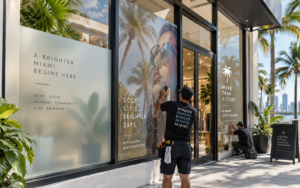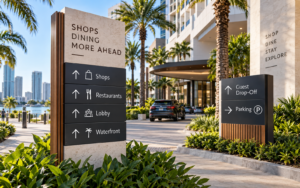
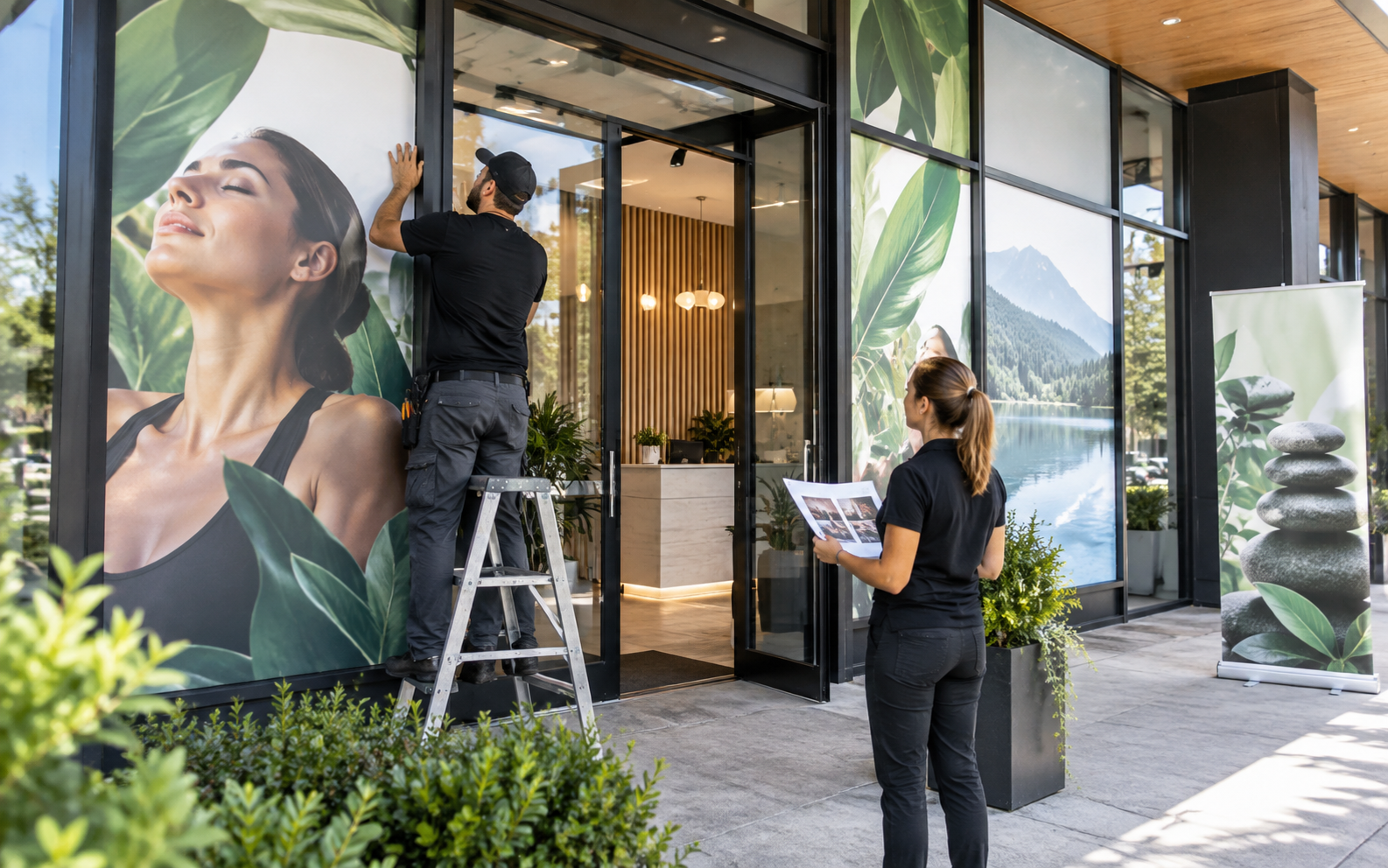
Large format print is a specialized form of printing used to produce oversized graphics such as banners, signage, wall graphics, vehicle wraps, posters, trade show displays, and other visual materials that go beyond standard printing dimensions. Also known as wide format printing, it allows businesses to communicate their message clearly across larger physical spaces.
Understanding the different types of large format production, the materials available, and the right type of large format printing for each application can help businesses avoid costly mistakes and achieve better visual results. In this guide, we explain how large format printing works, what equipment is used, which materials are most common, and when businesses should consider wide format solutions.
Article Outline
- What is large format print and how is it different from regular printing?
- How does the large format printing process work?
- What types of large format printing are available?
- What does a large format printer print on?
- What materials are used for large format print projects?
- What is large format print used for?
- What are the benefits of large format printing?
- How should artwork be prepared for large signage and banners?
- How do you choose the right large format printing solution?
- How can large format print support business marketing efforts?
What Is Large Format Print and How Is It Different From Regular Printing?
Large format print refers to graphics produced at dimensions that exceed those normally handled by conventional office printers and many traditional commercial printing presses. While standard printers are designed primarily for documents, brochures, postcards, and standard sheets of paper, large format systems have an expanded printing area capable of producing much larger visual materials.
The key difference between large format production and standard small format printing is not simply physical size. Large graphics must often remain readable from several feet away, or even while people walking or driving pass the installation. This changes the way designers approach typography, images, spacing, contrast, and the hierarchy of graphics and messages.
The printing industry uses specialized machines for these applications because many large print jobs cannot be completed on conventional printing presses. A professional large format printer may also handle materials that are flexible and durable, allowing brands to print on vinyl, fabric, boards, films, and other surfaces instead of paper.
How Does the Large Format Printing Process Work?
The printing process usually begins with a digital design created according to the final dimensions of the project. That file is then prepared using software that communicates with specialized printing equipment, determining how the image, colors, and text should be reproduced on the selected material.
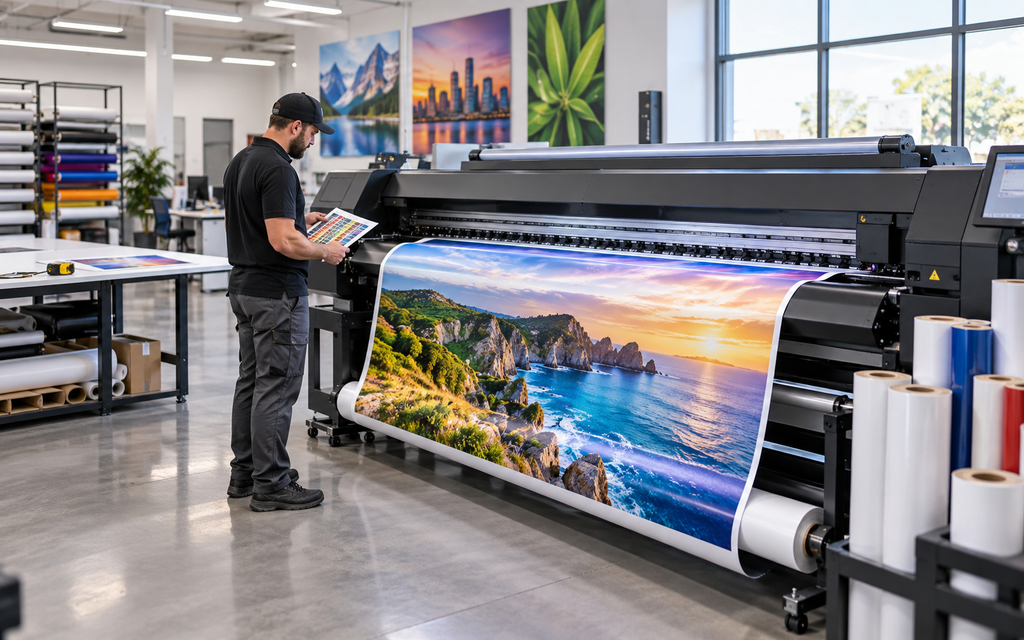
Modern digital printing technology allows the image to be transferred efficiently to a broad range of substrates. Depending on the machine, the material is placed either on a flat printing surface or fed through the equipment by rolling the materials from one side of the printer to the other.
Different ink technologies may also be used. Some systems work with liquid ink, while other production environments may use different ink formulations or technologies historically described as solid ink. UV printing systems use UV light to cure the ink quickly as it is applied, reducing or eliminating significant additional drying time and helping create durable printed graphics.
The exact production method should always be selected according to the application’s location, expected lifespan, material, and overall printing needs.
What Types of Large Format Printing Are Available?
There are several types of large format production, and the best choice depends primarily on the substrate and application.
One common type of large format printing is roll-fed or roll-to-roll production. Roll-to-roll printers are designed for flexible materials supplied in rolls, such as vinyl, adhesive films, banners, wall coverings, and certain fabrics. This method is frequently used for graphics that need to be cut, laminated, mounted, or installed after printing.
Another option is flatbed printing. A flatbed printer holds a rigid material in position while the printing system applies the image directly onto its surface. This allows businesses to print directly on boards, panels, corrugate, and other rigid materials instead of first printing on another material and mounting it afterward.
Professional wide format printers may support multiple technologies, giving printing experts greater flexibility when choosing the best solution for different printing projects.
What Does a Large Format Printer Print On?
A large format printer can print on a much broader selection of surfaces than a typical desktop printer. The precise range varies according to the machine, but commonly supported materials include vinyl, fabric, adhesive films, paper, banner materials, and rigid boards.
For flexible applications, wide-format production can accommodate materials used for banners, wall graphics, vehicle graphics, window displays, and temporary promotions. For rigid applications, specialized equipment can produce visual materials on boards suitable for displays, presentations, interior signage, and temporary promotional structures.
Choosing the correct substrate is critical because every application creates different demands. A graphic designed for an indoor conference does not require the same properties as outdoor signage exposed to sun, rain, humidity, or wind. A professional print provider should therefore recommend a durable material that can withstand the environment where the graphic will actually be installed.
What Materials Are Used for Large Format Print Projects?
Vinyl is one of the most recognizable materials associated with large format print because it is versatile, customizable, and suitable for many indoor and outdoor applications. It can be used for a banner, vehicle graphics, wall graphics, window graphics, lettering, and several forms of signage.
Banner materials are especially common. Standard vinyl works well for many applications, while mesh materials can be preferable for large banners installed in areas with significant wind exposure. A banner positioned on a fence or building may have very different material requirements than a banner displayed indoors at an event or meeting.
Paper is also used in selected applications. Custom posters may be produced on different paper stocks depending on the intended use. Technical drawing and blueprint paper needs may require specific paper products, while options such as 32 lb paper can be relevant for certain presentation or plan-printing applications. Specialized architectural drawings may also be printed on vellum where appropriate.
Rigid options such as foam board, PVC, and corrugate can be considered for displays, yard signs, retail graphics, event materials, and temporary promotional signs.
What Is Large Format Print Used For?
There are many applications used for large format production because businesses constantly need to communicate in physical spaces.
One of the most common applications is signage. Companies can use large-format graphics for storefront promotions, exterior signs, event banners, construction graphics, directional signs, retail promotions, and branded office environments. A business with a marquee in front of its location may use oversized visual communication to promote offers or reinforce its branding.
Retailers can use posters in your storefront windows, adhesive graphics, promotional signs, and graphics on aisle end caps to highlight products and campaigns. Because posters are cost-effective and often fast to produce, they can be useful when businesses need to communicate a timely promotion or seasonal offer.
Trade shows are another major application. A trade show display can include backdrops, booth graphics, banners, signs, table graphics, and informational panels. The goal is to communicate the company’s logo and taglines clearly while helping visitors understand the brand’s message quickly.
Other common applications include yard signs, wall graphics, vehicle wraps, real estate signage, construction graphics, floor graphics, corporate interiors, event backdrops, and promotional large signage.
What Are the Benefits of Large Format Printing?
One of the main benefits of large format printing is visibility. Large graphics can communicate a message from a distance, which makes them useful in busy environments where a smaller printed piece would be difficult to notice.
This increased visibility can reinforce branding, attract attention, promote products, and support broader marketing efforts. When a business uses strong imagery, a clear headline, recognizable branding, and an effective call to action, a large graphic can make a lasting impression on customers.
Another of the important benefits to using large format is versatility. A single visual identity can be adapted to banners, window graphics, wall graphics, trade show graphics, vehicle graphics, and signage. Businesses can therefore maintain a consistent brand presence across multiple physical touchpoints.
In situations where bigger is better, large format production also gives designers considerably more visual space. That does not mean every available inch should contain information. The most effective large graphics usually prioritize clarity over complexity.
How Should You Design Large Banners, Signage, and Trade Show Graphics?
A common mistake in large format print is taking artwork designed for a brochure or social media post and simply enlarging it. Large graphics require a different design approach because people usually see them from farther away.
Before you design your banner, determine the expected viewing distance and how quickly someone needs to understand the message. A banner seen from 10 feet away can accommodate different typography than signage viewed from across a parking lot or from a moving vehicle.
The primary message should be immediately understandable. Brand identity, logo and taglines, colors, photography, and calls to action should follow a clear hierarchy. A well-designed graphic does not need excessive information to be effective.
For a trade show display, the same principle applies. Visitors should understand the company’s core message within seconds. The booth environment can then provide additional information once the visitor is engaged.
Vector files are generally preferable for logos and typography because they can be scaled without losing sharpness. Raster images should have sufficient effective resolution for the final dimensions and anticipated viewing distance.
Does Large Format Printing Require Specialized Equipment?
Yes. Oversized printing applications generally require specialized machinery capable of handling both larger dimensions and unconventional materials.
Specialized printing equipment may include roll-fed printers, UV systems, cutting equipment, laminators, finishing machines, and flatbed systems. These machines are very different from ordinary office printers or many traditional commercial printing systems.
Some printers apply conventional ink to flexible materials, while UV systems cure ink rapidly during production. Flatbed technology can also produce graphics directly on rigid media, eliminating certain mounting steps for suitable applications.
The required printing technology depends on the project. Producing a temporary indoor banner is very different from producing a fleet graphic, rigid outdoor sign, wall wrap, or construction panel.
This is why choosing equipment should come after identifying the intended application—not before.
How Do You Choose the Right Large Format Printing Solution?
The best solution begins with where the finished graphic will be used.
Before selecting a material or production method, identify whether the graphic will be installed indoors or outdoors, how long it should remain in place, how far away people will view it, and whether it will be exposed to sunlight, rain, wind, humidity, or repeated handling.
For example, businesses preparing plans for a client’s space may prioritize precision, scale, and technical readability. Retail businesses may need window graphics or custom posters. A contractor may require yard signs or construction graphics. A company attending a trade show may prioritize portability, visual impact, and easy setup.
You should also consider finishing and installation requirements. Some graphics need lamination, contour cutting, mounting, hemming, grommets, or professional installation.
Instead of choosing solely according to price, evaluate the complete project: design, material, production, finishing, expected durability, installation, and viewing conditions.
Experienced printing experts can help determine which solution best matches the project’s goals and avoid paying for materials or production features that are unnecessary.
How Can Businesses Use Large Format Print to Strengthen Their Marketing?
Using large format printing strategically allows businesses to transform physical spaces into marketing assets.
A storefront window can promote an offer. A wall can communicate brand values. A vehicle can carry advertising throughout the city. A construction barricade can display project information. A trade show booth can create a recognizable environment that attracts visitors.
Businesses can also coordinate multiple print products around a campaign. A retail launch, for example, might combine window graphics, posters, a banner, floor graphics, and in-store displays to create a unified customer experience.
The strongest applications connect physical visibility with a clear objective. Every graphic should answer a simple question: What do you want the viewer to understand or do?
When the format, design, placement, and material work together, large format print becomes more than oversized decoration. It becomes an important component of a company’s broader visual communication strategy.
For businesses in Miami, Graphic Arts 305 provides solutions including banners, wall and window graphics, vehicle and fleet graphics, trade show materials, commercial signage, and other large-format applications designed around the specific environment where each piece will be used.
What to Remember About Large Format Printing
- Large format print is designed for oversized visual communication beyond conventional printing dimensions.
- Wide format printing can be used for banners, wall graphics, window graphics, vehicle wraps, posters, signs, retail displays, and trade show graphics.
- The right material depends on whether the project will be indoors, outdoors, temporary, permanent, flexible, or rigid.
- Roll-to-roll equipment is commonly used for vinyl and other flexible media, while flatbed systems can print directly onto rigid substrates.
- A professional large format printer requires specialized equipment to handle larger dimensions and different materials.
- Good large-format design prioritizes readability, contrast, viewing distance, and clear visual hierarchy.
- A banner, sign, or trade show graphic should communicate its main message within seconds.
- Outdoor applications require materials and finishing appropriate for sun, rain, wind, humidity, and other environmental conditions.
- File preparation, material choice, finishing, and installation all influence the final result.
- Effective large format graphics can help businesses increase visibility, reinforce branding, and make a lasting impression.
Large format printing is ultimately about more than producing something bigger. The right combination of design, material, printing technology, and placement turns physical surfaces into communication opportunities.
Need help with your next large format printing project? Contact Graphic Arts 305 to discuss your banner, signage, trade show display, wall graphics, window graphics, vehicle graphics, or custom printing needs.