Choosing the right outdoor signs in Miami is about much more than placing a company logo outside a building. Effective exterior communication combines visibility, durability, branding, appropriate materials, and a design that works in the real environment where customers will see it.
From storefront identification and yard signs to window graphics, rigid panels, illuminated solutions, and a vehicle wrap, every application should have a clear purpose. Miami businesses also have to consider intense sunlight, humidity, heavy rain, heat, traffic patterns, viewing distance, and the architecture surrounding the property.
This guide explains how to choose an outdoor sign, which materials work for Florida conditions, how design affects visibility, and what companies should evaluate before production or installation. Whether you are opening a new location, updating an existing storefront, or planning a temporary promotion, understanding these factors can help you invest in signage that works harder for your company.
Article Outline
- Why does outdoor signage matter for businesses in Miami?
- What type of sign is right for your business location?
- Which materials make custom outdoor signs more durable?
- How should a business sign be designed for better visibility?
- When should you use yard signs, banners, or temporary displays?
- How can window graphics and vehicle wraps extend your brand?
- Should indoor and exterior graphics follow the same visual identity?
- What should businesses consider before they install signage?
- How can exterior signs support advertising and customer recognition?
- How do you choose a sign service in Miami, FL?
Why Does Outdoor Signage Matter for Businesses in Miami?
Your exterior signage is often one of the first physical interactions someone has with your company. Long before a potential customer speaks with an employee, enters a store, visits an office, or purchases a product, your exterior presence may already be communicating something about your company.
That matters in a visually competitive city. Retail centers, restaurants, office buildings, hotels, warehouses, medical facilities, real estate developments, and entertainment venues are constantly competing for attention. Strong signage can make a company easier to recognize while helping people understand where it is and what it offers.
Unlike many forms of digital advertising, physical communication remains in place throughout the day. Someone may pass a storefront repeatedly on the way to work before ever becoming a customer. Those repeated visual impressions can help build familiarity and reinforce the company’s identity over time.
A professionally produced sign therefore performs more than one role. It identifies a property, communicates professionalism, supports marketing, and creates a visual connection between the physical location and the rest of the company’s communications.
What Type of Sign Is Right for Your Business Location?
There is no universal solution that works equally well for every property. The correct type of sign depends on the environment, viewing distance, traffic patterns, purpose, expected lifespan, and available installation surfaces.
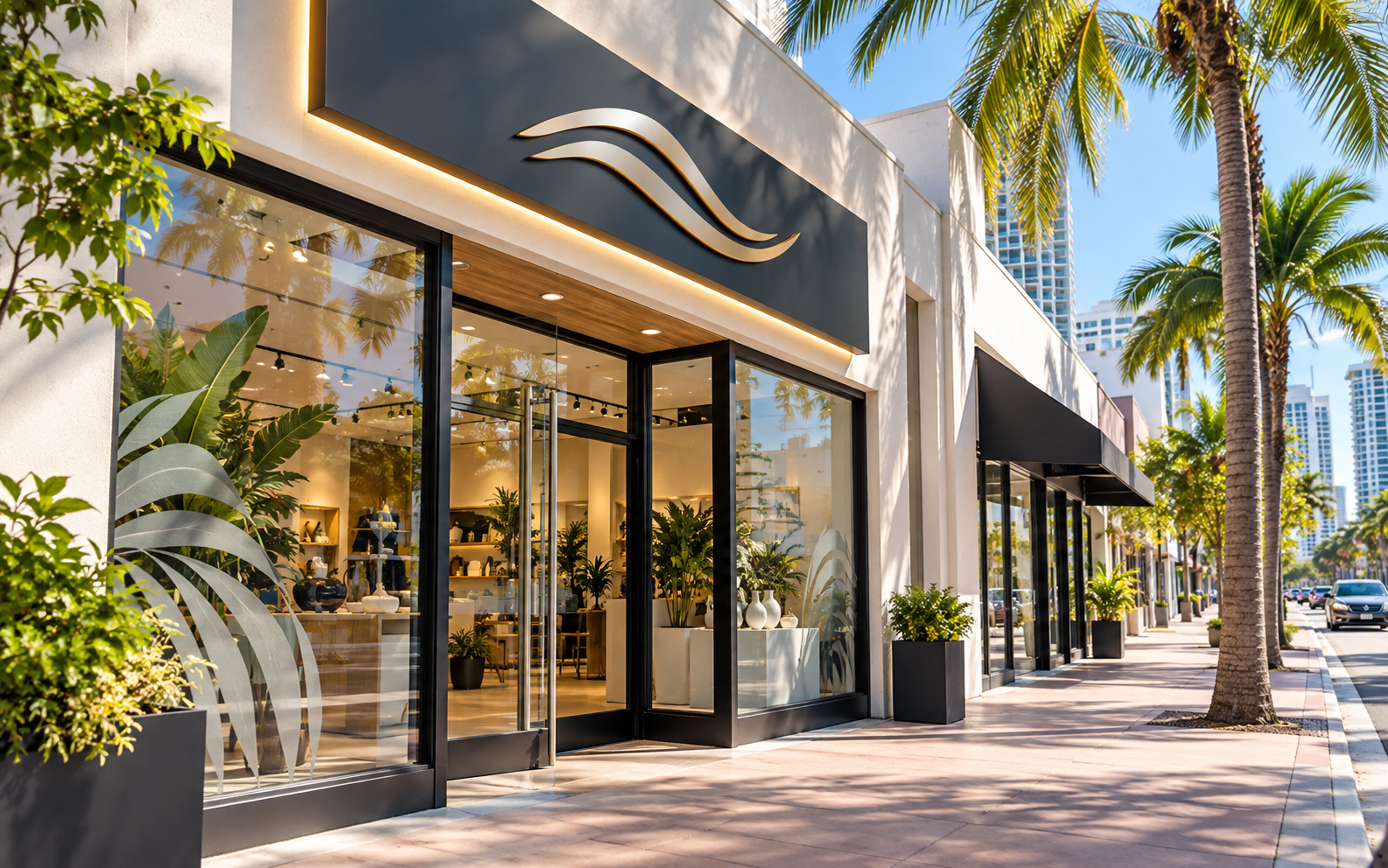
A retail store viewed primarily by pedestrians may need dimensional lettering, illuminated identification, or strong storefront graphics. A building positioned farther from the road may require larger lettering and a simpler message that remains readable from a greater distance.
Real estate companies may need yard applications, property panels, directional pieces, or post-mounted systems. Construction companies can use rigid project panels, banners, fence graphics, and directional communication. Restaurants and hospitality properties may combine permanent identification with promotional graphics that change throughout the year.
Before selecting a format, identify the primary objective. Does the piece need to identify your company? Direct visitors? Promote an offer? Announce a new development? Increase recognition from passing traffic?
Once that objective is clear, dimensions, materials, placement, and production method become much easier to determine.
Which Materials Make Custom Outdoor Signs More Durable?
Material selection has a major impact on appearance, performance, and lifespan. In Florida, exterior graphics may face strong sunlight, humidity, rain, heat, and changing weather conditions, which means materials should be selected for the actual environment rather than appearance alone.
Metal and aluminum composite panels are common choices for rigid applications because they provide a smooth surface and strong structural properties without becoming excessively heavy. They can be useful for property identification, construction projects, directional communication, parking areas, and commercial applications.
Vinyl is another versatile material. Depending on the specific product, it can be applied to windows, vehicles, rigid substrates, promotional surfaces, and architectural elements.
Certain plastic materials may also work well for temporary displays or lightweight applications. Corrugated substrates, for example, are frequently selected when portability and economical production are important.
However, a durable outdoor solution is not defined by the substrate alone. Ink quality, lamination, finishing, surface preparation, mounting hardware, sun exposure, and installation method can all influence performance.
Choosing the cheapest material without considering its intended use may ultimately cost more if the finished piece fades, warps, peels, or requires premature replacement.
How Should a Business Sign Be Designed for Better Visibility?
A design can look impressive on a large computer monitor and still perform poorly once placed on a building. Exterior communication has to function at the distance and speed at which real people will encounter it.
The first priority should be hierarchy.
What should someone understand first?
For many business signs, that will be the company name. In other cases, the primary message may be a service, an offer, or a directional instruction. Whatever the priority is, it should receive the strongest visual emphasis.
Typography also plays an important role. Thin fonts, overly decorative lettering, or excessive text may become difficult to understand from across a parking lot or moving vehicle.
Contrast matters as well. The main message needs enough separation from the background to remain visible under changing daylight conditions.
Think about how much time the viewer has. Someone standing outside a storefront can read considerably more information than a driver passing the property. Strong exterior design removes unnecessary information and lets the essential message dominate.
Good visibility usually comes from simplicity rather than adding more content.
When Should You Use Yard Signs, Banners, or Temporary Displays?
Not every marketing need requires permanent construction. Temporary formats can be highly effective when campaigns change frequently or when information only needs to remain in place for a limited period.
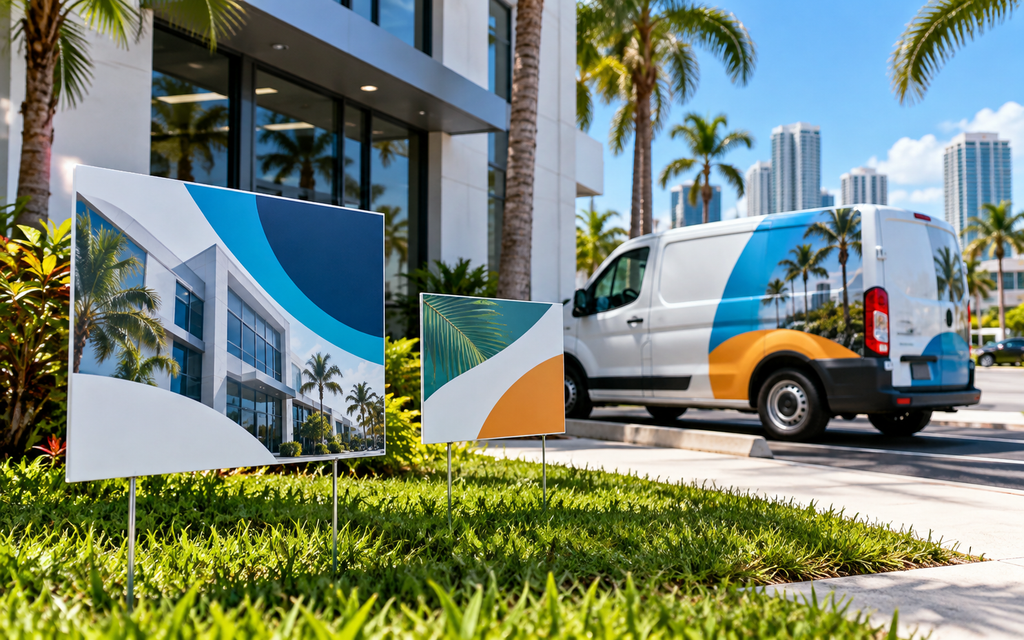
Real estate listings, open houses, construction announcements, property management, local services, political-neutral community information, special events, and directional needs can often be communicated through yard signs or lightweight rigid panels.
Banners provide another flexible option. They may be appropriate for grand openings, seasonal promotions, limited-time offers, sponsorships, events, new product announcements, and temporary storefront communication.
The key advantage is adaptability. A temporary display can be replaced as campaigns change without modifying the permanent architecture of the building.
Temporary, however, should not mean poorly produced.
Image resolution, color reproduction, finishing, proportions, mounting, and readability still influence how people perceive the company. A low-quality temporary piece can weaken the impression created by an otherwise professional storefront.
How Can Window Graphics and a Vehicle Wrap Extend Your Brand?
The primary building identification is only one part of a physical branding system. Existing surfaces can provide additional opportunities to communicate with people around your property and throughout the city.
A window can be used to reinforce visual identity, communicate opening hours, promote services, provide privacy, or introduce seasonal campaigns. Thoughtfully designed graphics can make unused glass surfaces more functional without overwhelming the storefront.
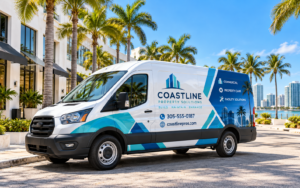
Vehicles provide another opportunity. Professionally designed graphics can transform cars, vans, or commercial fleets into mobile visual assets that carry company messaging beyond the original location.
The most important factor is consistency.
The colors, typography, logos, photography, and other graphic elements used across a storefront, vehicle, printed piece, website, and social media should feel connected.
When each physical touchpoint follows the same visual system, the brand becomes easier to recognize. Instead of isolated marketing materials, the company develops a coordinated identity that customers can encounter in different environments.
Should Indoor and Outdoor Graphics Follow the Same Visual Identity?
Exterior and indoor communication should clearly belong to the same company, but that does not mean every application needs to be designed identically.
Exterior communication usually has to work from longer distances and in less controlled conditions. Messages therefore often need to be shorter, typography larger, and contrast stronger.
Inside a building, visitors are generally closer to the graphics and have more time to process information. Interior applications can therefore include additional detail, explanatory information, environmental branding, directional systems, or decorative elements.
The transition between the two environments should still feel intentional.
Someone who recognizes the company from outside should experience a consistent visual language after entering the building. That continuity contributes to a more professional customer experience and reinforces recognition at every stage of the visit.
What Should Businesses Consider Before They Install Signage?
Installation should be considered before production begins, not after the artwork has already been approved.
The surface where the piece will be mounted can influence dimensions, materials, finishing, hardware, and production method. A concrete wall presents different requirements from glass, fencing, posts, or an architectural façade.
Viewing conditions also matter. Nearby trees, parked vehicles, columns, awnings, landscaping, neighboring properties, and traffic direction can obstruct the message.
Height and viewing angle are equally important. A beautifully designed piece positioned outside the natural line of sight may deliver less value than a simpler piece placed strategically.
Businesses should also investigate applicable property requirements, landlord restrictions, and local permitting rules before they install permanent exterior elements.
Addressing these factors early reduces the risk of producing something that later has to be resized, relocated, reconstructed, or replaced.
How Can Exterior Signs Support Advertising and Customer Recognition?
Physical communication can contribute to marketing beyond simply telling people where a company is located.
Repeated exposure creates familiarity. Someone may see the same storefront dozens of times before eventually needing the company’s services. When that need appears, familiarity can help the company come to mind.
This is one reason signs help connect physical presence with broader marketing strategies.
A storefront, directional panel, vehicle, promotional banner, or event installation can reinforce the same messages people encounter through search engines, social media, email marketing, and other channels.
Consistency is particularly valuable. If the same logo, visual identity, messaging style, and value proposition appear across different channels, individual marketing activities reinforce one another.
Companies can also use temporary graphics alongside permanent identification. The permanent elements communicate who the company is, while changeable elements promote current offers, products, services, or events.
Together, these layers create a more complete physical marketing system.
How Do You Choose a Sign Service in Miami, FL?
A professional provider should do more than simply reproduce the artwork a company supplies.
A complete service should consider the environment, purpose, materials, dimensions, production requirements, finishing, expected lifespan, and installation conditions before recommending a solution.
For example, a three-day promotional event has very different requirements from permanent building identification. A piece viewed from a sidewalk needs a different design approach from one intended to attract drivers across several traffic lanes.
These distinctions affect the entire project.
Graphic Arts 305 works with companies looking to create signs and visual communication solutions for storefronts, properties, events, commercial environments, and promotional applications.
Available options can include rigid panels, large-format projects, banners, acrylic solutions, backlit applications, vehicle graphics, storefront graphics, and other custom outdoor signs designed around the requirements of the space.
Rather than selecting a product only because it appears in a catalog, businesses should begin with the purpose of the project.
Where will people see it?
How far away will they be?
How long does it need to remain in place?
What should they understand immediately?
Answering those questions first makes it easier to select a solution that represents the company professionally and performs effectively in real-world conditions.
Key Things to Remember
- Begin with the purpose of the project before choosing materials or dimensions.
- Consider viewing distance, traffic speed, surrounding architecture, and placement.
- Use materials appropriate for Florida’s environmental conditions and expected lifespan.
- Keep the primary message clear and easy to understand quickly.
- Prioritize strong typography and contrast rather than excessive information.
- Coordinate storefront graphics, vehicles, windows, printed materials, and digital communication.
- Use temporary formats when promotions or messages need to change frequently.
- Consider mounting and installation requirements before production starts.
- Match production quality to the impression you want customers to have of your company.
- Treat exterior communication as part of a complete marketing system rather than an isolated printed product.
- Choose solutions according to the actual site instead of relying on one-size-fits-all products.
- Work with a provider that can connect design, production, material selection, finishing, and installation considerations.
Need professional exterior signage for your next project? Graphic Arts 305 can help you select the right materials, format, and production solution for your space. Contact our team to discuss your project and request a quote.