A professional vehicle wrap can turn an ordinary car, van or truck into a mobile advertising asset that promotes your company every day. For businesses searching for fleet wraps Miami, the opportunity goes beyond changing the appearance of a vehicle. A carefully planned fleet wrap can improve recognition, support business branding and create a consistent identity across an entire fleet.
This guide explains how vehicle wraps in Miami work, which coverage option may be right for your business, what affects cost and durability, and how to choose experienced wrap specialists. It also explores related services such as paint protection film, ceramic coating, window tint and professional installation.
Article Outline
- What is a commercial vehicle wrap?
- Why should Miami businesses invest in fleet branding?
- What makes an effective fleet wrap design?
- Which types of vehicles can be wrapped?
- Full wrap, partial wrap or vinyl graphics?
- How does the professional vehicle wrap process work?
- Can wraps protect a vehicle’s paint?
- How long do fleet wraps last in Miami?
- How much do commercial vehicle wraps cost?
- How should businesses choose vehicle wrap experts?
- Are PPF, tint and ceramic coating useful additions?
- How can fleet advertising generate more visibility?
What Is a Commercial Vehicle Wrap?
A commercial wrap is a custom layer of adhesive vinyl applied to the exterior of a business vehicle. It can display a company name, logo, website, phone number, services and other visual elements designed to promote your business.
Unlike a basic magnetic sign or small door decal, a professional vehicle wrap can transform the full appearance of a vehicle. It may cover the entire body or only selected panels, depending on the company’s goals, budget and branding strategy.
Materials from manufacturers such as 3M and Avery Dennison are frequently used for commercial applications. These products are designed to conform to curves, body lines, recesses and other complex vehicle surfaces when handled by trained installers.
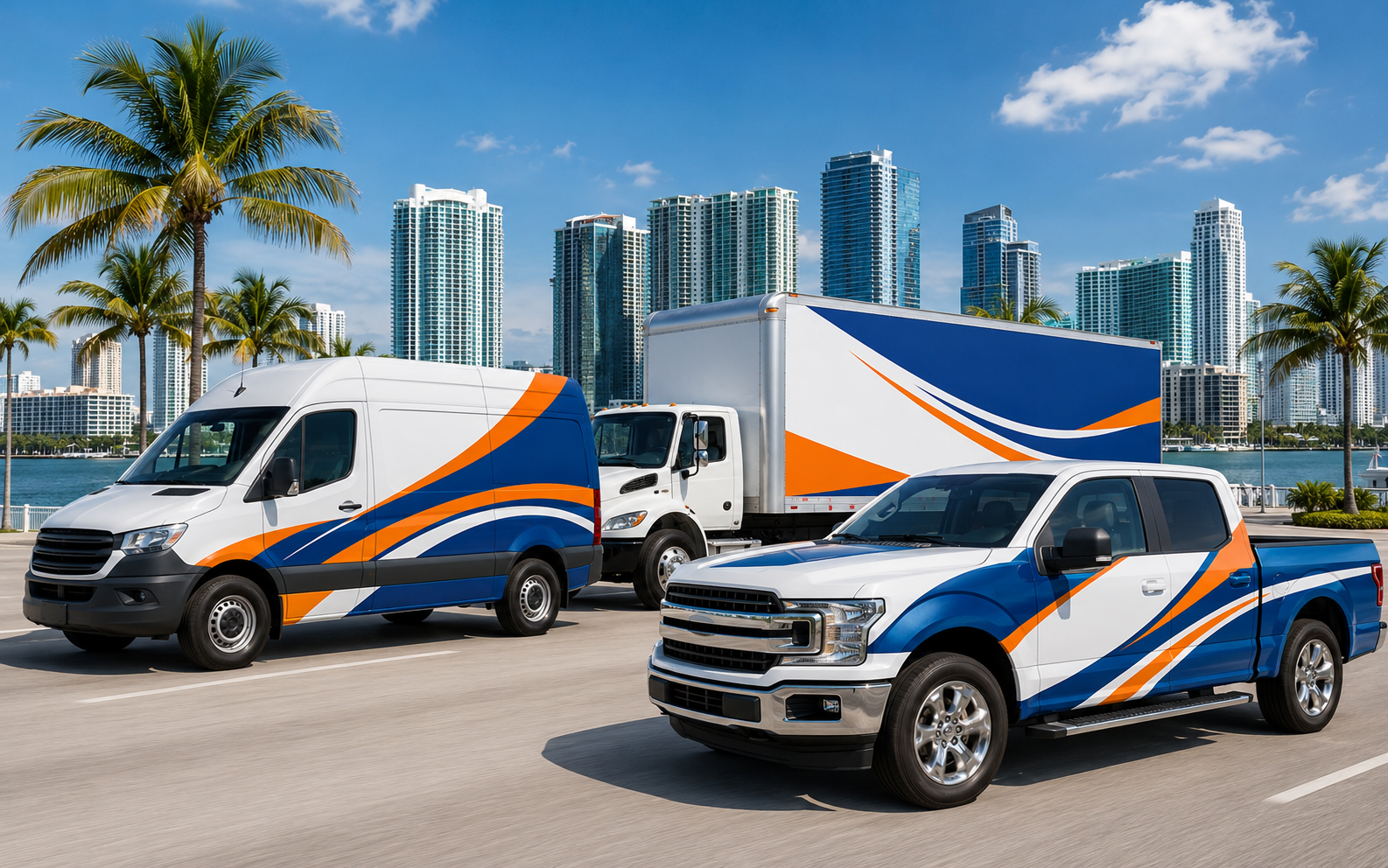
A business can wrap one company car, one van or dozens of vehicles. The term fleet does not require hundreds of units. Even two or three branded vehicles can create a consistent and recognizable presence across Miami.
Why Should Miami Businesses Invest in Fleet Branding?
Companies in Miami operate in a busy and highly visual market. Service vehicles travel through areas such as Doral, Brickell, Kendall, Hialeah, Coral Gables and Downtown, creating repeated opportunities to reach potential customers.
A wrapped vehicle can advertise while driving, making deliveries, visiting properties or remaining parked outside a job site. This makes vehicle advertising one of the most cost-effective ways to maintain ongoing local visibility without paying for every individual impression.
A single commercial vehicle may be seen by thousands of potential customers over time. When several branded vehicles operate across Miami, that exposure becomes more consistent and geographically diverse.
Fleet branding can be especially useful for:
- Contractors
- HVAC companies
- Plumbing businesses
- Cleaning companies
- Delivery services
- Property managers
- Landscaping companies
- Construction firms
- Mobile service providers
- Food and catering businesses
- Healthcare transportation companies
- Real estate teams
A professional fleet image also helps create trust. When a clearly branded vehicle arrives at a residential or commercial property, customers can immediately identify the company and its employees.
What Makes a High-Impact Fleet Wrap Design?
A strong wrap design must communicate quickly. Drivers and pedestrians often have only a few seconds to see the vehicle, understand the message and remember the company.
The most effective layouts typically prioritize three questions:
- Who is the company?
- What service does it provide?
- How can a customer make contact?
A vehicle graphic should usually include the business name, logo, main service, phone number and website. Additional information may be added, but too much text can weaken the design.
High-impact graphics do not require complicated illustrations or excessive detail. Bold contrast, large typography and a clear hierarchy are often more effective than a visually crowded layout.
The original color and shape of the vehicle should also be considered. Doors, handles, windows, wheel wells, body seams and rear panels can interrupt important information if they are ignored during the wrap design stage.
For a commercial fleet, the challenge becomes more complex. A design created for a sedan cannot simply be stretched onto a box truck or cargo van. Each layout must be adapted while maintaining the same colors, logo treatment and visual identity.
Which Types of Vehicles Can Be Wrapped?
Most commercial vehicles with suitable painted surfaces can receive vinyl wrapping. This gives businesses considerable flexibility when building a branded fleet.
Common types of vehicles include:
- Sedans
- SUVs
- Pickup trucks
- Cargo vans
- Passenger vans
- Box trucks
- Delivery trucks
- Trailers
- Food trucks
- Buses
- Utility vehicles
- Specialty service vehicles
Different vehicles provide different advertising opportunities. A small custom car may work well for sales representatives, real estate professionals or mobile consultants. A large truck offers more surface area for bold messaging and oversized branding.
A van is often particularly effective because it provides broad side panels and large rear doors. These areas can support readable contact information and simple service-focused graphics.
Businesses managing mixed vehicles should work with a provider that can design and produce layouts for each body type. This ensures the brand remains recognizable even when the vehicle dimensions vary significantly.
Full Wrap, Partial Wrap or Vinyl Graphics?
There are several approaches to commercial vehicle wraps. The right choice depends on the desired impact, vehicle condition, budget and amount of information to display.
Full vehicle wrap
A full wrap covers most painted exterior surfaces. It can completely change the visual appearance of the vehicle and provides the largest creative canvas.
Full coverage is often selected by businesses seeking maximum brand impact or a major visual transformation. It can also help companies create consistency when their vehicles have different original paint colors.
Partial wrap
A partial wrap covers selected areas while allowing the original vehicle color to remain visible. Common applications include the rear section, doors, lower body panels or a large diagonal section along the sides.
A partial wrap can be highly effective when the original paint color works with the company’s identity. It should be designed as a complete visual concept rather than treated as a reduced version of a full wrap.
Spot graphics and lettering
Vinyl graphics may include the logo, phone number, website and service information without covering large portions of the body.
This is often a cost-effective option for smaller companies or businesses that prefer a clean, minimal presentation. The layout still needs careful planning to remain visible and professional.
How Does the Professional Vehicle Wrap Process Work?
A successful wrap project requires more than printing and applying material. It involves strategy, design, preparation, production and expert installation.
Business assessment
The provider should first understand the company, audience, service area and marketing goals. A local home-service company will have different communication needs from a logistics company operating a large commercial fleet.
Vehicle inspection
The make, model, year and configuration of each vehicle must be documented. Existing dents, rust, scratches, peeling clear coat or previous repairs should also be evaluated.
Paint correction may be recommended when surface defects could affect appearance or adhesion. Wraps are not designed to hide serious body damage or unstable paint.
Creative development
The design team uses brand assets such as logos, fonts, colors and key messages to create a custom vehicle concept. Accurate templates help position graphics around vehicle features.
Proofing
Before production, the client should verify all contact information, service descriptions and visual placements. Phone numbers and website addresses should be checked carefully.
Printing and finishing
The graphics are printed, laminated and prepared for installation. Quality materials and proper production settings contribute to color consistency and long-term performance.
Professional installation
Installers apply the material to a clean, properly prepared vehicle in a controlled environment. They work around curves, recessed sections, seams and edges while minimizing bubbles, tension and distortion.
Experienced companies may have 15 years of experience or more, but years alone do not guarantee quality. Businesses should also review recent projects, installation standards and fleet management capabilities.
Can Wraps Protect a Vehicle’s Paint?
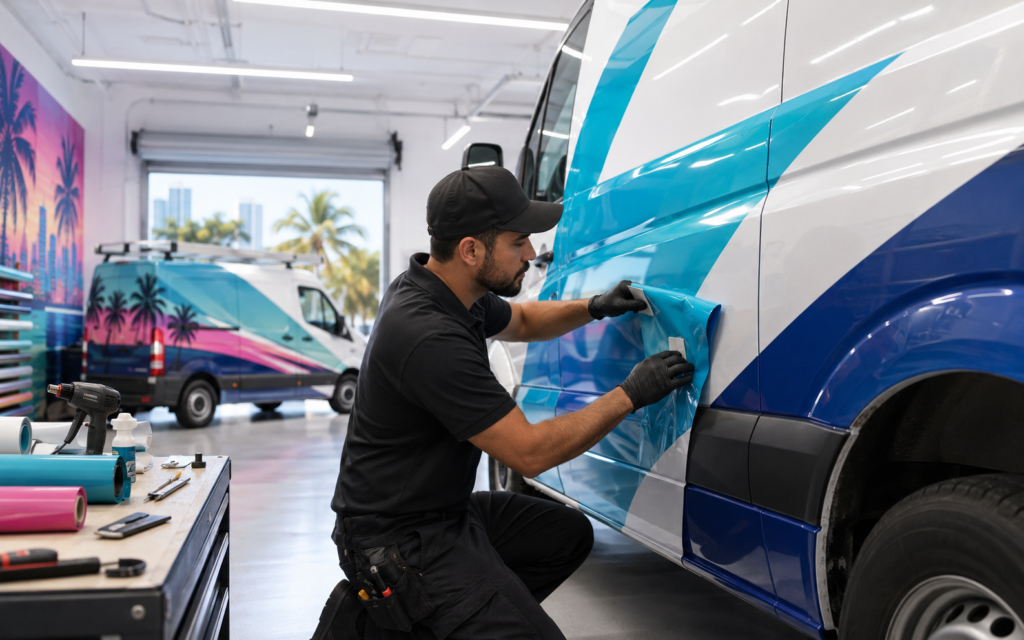
Commercial wraps can provide a layer of vehicle protection over the painted surfaces they cover. The vinyl may help reduce exposure to minor scratches, road contaminants, sunlight and everyday wear.
However, this does not mean wraps protect against every type of damage. They cannot prevent dents, major impacts, corrosion or damage caused by poor maintenance.
Wraps protect best when installed over factory paint in good condition. Peeling paint, rust, damaged clear coat and low-quality body repairs can cause adhesion problems and may worsen during removal.
Businesses that prioritize more advanced paint protection may consider paint protection film. Also known as PPF, this transparent film is designed primarily to protect painted surfaces rather than display advertising.
A company may use branding vinyl on major exterior panels and apply paint protection film to vulnerable sections such as bumpers, mirrors or high-impact areas. The correct approach depends on the vehicle’s use and desired long-lasting protection.
How Long Do Fleet Wraps Last in Miami?
The useful life of a wrap depends on material quality, installation, maintenance, mileage and environmental exposure.
Miami’s climate can be demanding. Strong sunlight, high temperatures, humidity, rain and coastal conditions may affect exterior graphics over time.
Vertical panels often age differently from horizontal surfaces such as hoods and roofs because horizontal areas receive more direct sunlight. Vehicles stored indoors or under covered parking may retain their appearance longer than those continuously exposed outdoors.
Other factors include:
- Frequency of washing
- Use of abrasive brushes
- Pressure washing near edges
- Fuel and chemical spills
- Road debris
- Driver habits
- Frequency of vehicle use
- Quality of installation
- Condition of the original paint
Businesses should wash wrapped vehicles regularly with mild products and non-abrasive tools. Aggressive automatic car washes may cause premature edge wear.
A maintenance plan should include periodic inspections. Lifted edges, scratches or damaged panels should be evaluated before the problem spreads.
How Much Do Fleet Wraps Cost in Miami?
There is no universal price for fleet wraps because every project is different. The cost depends on the vehicle, coverage, materials, design complexity and number of units.
Important pricing factors include:
- Vehicle size
- Full or partial coverage
- Number of vehicles
- Custom wraps or simple lettering
- Removal of old graphics
- Surface preparation
- Design requirements
- Material selection
- Installation complexity
- Scheduling needs
- Repairs or body preparation
A custom vehicle with deep recesses or unusual equipment may require more labor than a standard cargo van. Similarly, a fleet containing several makes and models requires multiple production layouts.
Businesses comparing quotes should confirm what is included. A lower estimate may exclude design, removal, surface preparation, premium laminate or future replacement graphics.
The best proposal is not necessarily the cheapest. A poorly designed or installed wrap can remain on the road for years while failing to communicate clearly.
How Should Businesses Choose Vehicle Wrap Experts?
Not every sign company is equipped to manage vehicle wraps for businesses across Miami. Commercial fleet projects require specific design, production and installation capabilities.
When comparing wrap specialists, businesses should ask about:
- Commercial portfolio
- Experience with similar vehicles
- Materials and laminates
- Installation environment
- Design process
- Warranty terms
- Repair procedures
- Removal services
- Color consistency
- Fleet documentation
- Scheduling capacity
- Support for future vehicles
Miami’s trusted experts should be able to explain the complete process, not merely provide a price. The provider should identify risks, inspect the vehicle and recommend a solution based on actual operating needs.
Companies should also evaluate whether the installer can handle an entire fleet without removing too many vehicles from service simultaneously. Phased installation may help reduce disruption.
Vehicle wrap experts should maintain organized design files and production records. These files make it easier to recreate graphics after an accident or wrap newly purchased vehicles later.
Are PPF, Tint and Ceramic Coating Useful Additions?
Fleet wrapping is usually focused on advertising and brand recognition, but other services in Miami may support comfort, appearance or vehicle preservation.
Paint protection film
Paint protection film is a clear material applied to vulnerable surfaces. It can help protect your investment against chips, scratches and minor road debris. It serves a different purpose from printed commercial graphics.
Ceramic coating
Ceramic coating creates a protective surface layer that may make cleaning easier and improve resistance to certain contaminants. Not every coating is compatible with every wrap material, so the installer and coating provider should confirm suitability.
Window tint
Window tint may improve privacy, reduce glare and help manage interior heat. Commercial vehicles must still comply with applicable tint regulations.
Windshield protection
Some providers also offer windshield protection films designed to reduce damage from small road impacts. Suitability depends on the product, vehicle and local requirements.
These services should not distract from the core objective of a commercial wrap. They are additions to a broader vehicle customization and protection strategy.
How Can Fleet Advertising Generate More Visibility?
A branded vehicle works throughout the day without requiring the company to purchase each individual impression. This makes it an effective way to advertise locally.
Fleet vehicles may be seen:
- In traffic
- At job sites
- Outside customer properties
- In commercial parking areas
- During deliveries
- At events
- At company facilities
- Throughout Miami and South Florida
The rear of the vehicle is particularly valuable because drivers may view it for extended periods in traffic. It should include a simple message, readable contact information and clear branding.
To improve measurement, businesses can use a dedicated landing page, trackable phone number or promotional code. Customer service teams can also ask new leads where they first encountered the company.
Vehicle wraps rarely operate in isolation. They are more effective when the same colors, logo and message appear on the website, social media, uniforms, print materials and digital advertising.
This consistency helps boost your brand’s visibility and makes it easier for potential customers to recognize the business across different platforms.
What Makes Fleet Wraps Valuable for Small and Large Companies?
Small companies often use their first wrapped vehicle to appear more established and recognizable. One professionally branded service vehicle can strengthen credibility when arriving at a customer’s property.
Larger organizations use fleet graphics to maintain consistency across locations, departments and types of vehicles. A controlled visual system helps every unit look connected to the same organization.
The strategy should be scalable. As the business adds vehicles, the wrap provider should be able to reproduce the design without rebuilding the campaign from the beginning.
For companies with many vehicles, identifiers can also be incorporated into the graphics. Unit numbers, department names or regional markers can support operations without disrupting the main brand identity.
Frequently Asked Questions About Fleet Wraps Miami
Can I wrap only one business vehicle?
Yes. A single vehicle can be the first step toward a larger fleet branding program. The design can be prepared so it can later be adapted to additional units.
Can different vehicle models share the same design?
They can share the same brand system, but the artwork should be adjusted for each model. A direct copy may create alignment and legibility problems.
Can a leased vehicle be wrapped?
Often yes, but the lease agreement should be reviewed first. Some leasing companies require written approval or specific removal conditions.
Can wraps be removed?
Professional wraps can generally be removed, but the final result depends on the age of the material and condition of the paint underneath.
Can damaged wrap sections be replaced?
Individual panels can often be reproduced and replaced. Keeping accurate production files helps maintain visual consistency.
Should I include a QR code?
A QR code can be useful when the vehicle is parked, but it should not replace a clearly visible website or phone number.
Is vinyl wrapping suitable for old vehicles?
It depends on the paint and body condition. Vehicles with rust, peeling clear coat or unstable repairs may need corrective work before installation.
How quickly can I wrap my vehicle?
The schedule depends on design approval, production, vehicle size and coverage. Large projects may be completed in phases to avoid operational disruption.
Key Points to Remember
- A fleet wrap transforms a company vehicle into a mobile branding and advertising asset.
- Effective graphics prioritize the company name, main service and contact information.
- Full wraps, partial wraps and spot graphics serve different budgets and marketing goals.
- Miami car wraps require materials and installation methods suitable for heat, sunlight and humidity.
- A commercial fleet needs consistent branding adapted to each vehicle model.
- Materials from 3M and Avery Dennison are widely used for professional applications.
- Wraps can provide limited paint protection, but they are not a substitute for PPF or body repair.
- Professional installation and proper maintenance affect durability.
- Fleet advertising can reach potential customers while vehicles are driving or parked.
- The best wrap company should provide strategy, design, production, installation and ongoing fleet support.
Turn Every Vehicle Into a Mobile Advertisement
Your vehicles already travel through Miami’s neighborhoods, commercial areas and major roads. Without branding, those miles represent a missed visibility opportunity.
A professionally designed fleet wrap can help people recognize your company, understand what you offer and remember how to contact you. Whether you operate one service van or a large commercial fleet, consistent vehicle branding can create a stronger presence across Miami.
Work with Miami’s trusted experts to design custom car wraps and commercial graphics that support your brand, fit your vehicles and communicate clearly. With the right materials, strategy and expert installation, every trip can become a way to promote your business.