Planning a successful trade show in Miami requires much more than reserving floor space and printing a few banners. Your booth must communicate your value quickly, look professional from every angle, and give attendees a clear reason to stop.
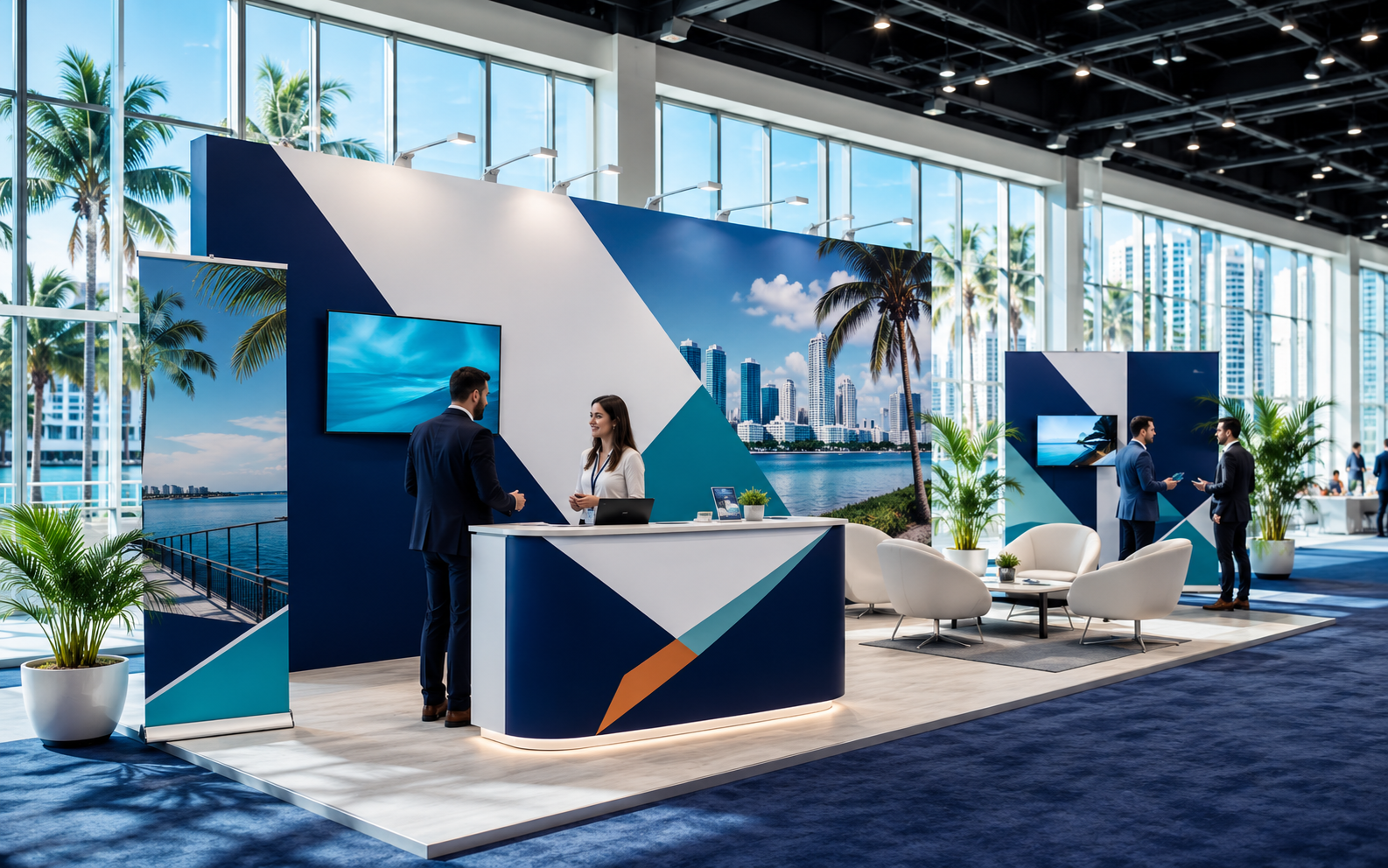
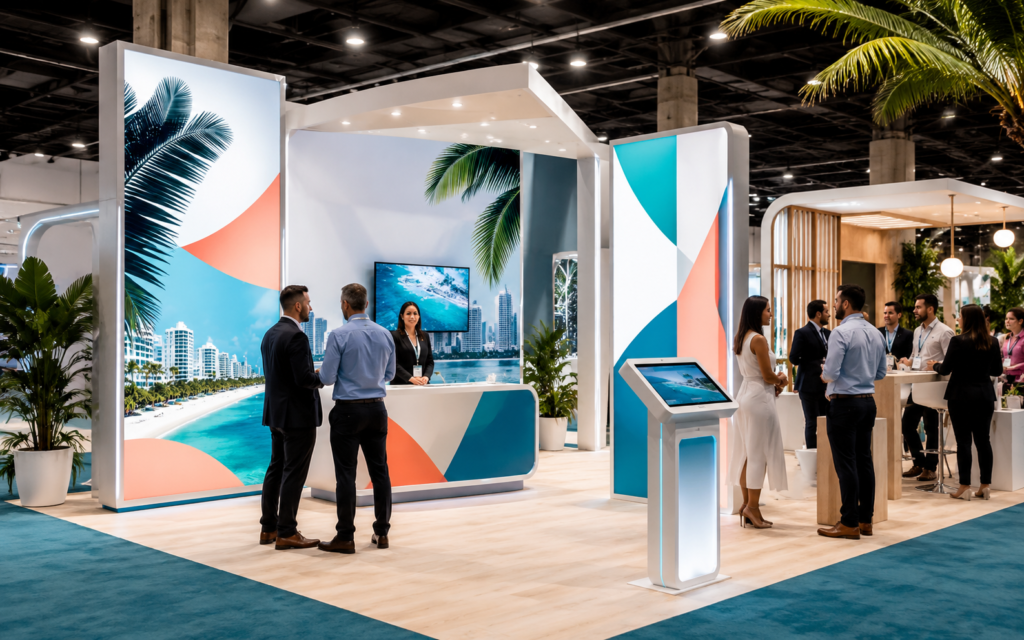
Professional trade show booth graphics Miami businesses can rely on help transform an empty exhibit space into a branded environment. From portable banner stands and fabric backdrops to illuminated walls, counters, kiosks, and complete custom structures, every visual element should support the same message.
This guide explains how to select the right trade show display, prepare effective artwork, coordinate production, and manage the practical details of exhibiting in South Florida. It is worth reading because it can help you avoid common design and production mistakes before your next trade show.
Why Are Professional Trade Show Graphics Essential in Miami?
A trade show is a visually competitive environment where attendees make decisions within seconds. Before they speak with your sales team, scan a QR code, or request a product demonstration, they evaluate your company through the appearance and clarity of your exhibit.
Professional graphics help organize your message, reinforce your visual identity, and create a credible space for business conversations. They allow visitors to understand who you are, what you offer, and why they should enter your booth without having to read several paragraphs.
This is especially important in Miami, a major tourist destination and international business hub that attracts exhibitors, buyers, and industry professionals from the United States, Latin America, the Caribbean, and Europe. At crowded Miami trade shows, poorly designed graphics can disappear into the background.
A coordinated visual system can help your company stand out from the competition. The backdrop, counter, banner, floor decal, table cover, and product signage should all work together to reflect your brand instead of looking like unrelated promotional pieces.
Miami’s unique mix of industries and international audiences also means that your message may need to be understood by people from different markets. Clear headlines, strong images, simple benefits, and concise calls to action are more effective than complicated visual presentations.
What Makes an Effective Trade Show Booth?
An effective trade show booth should communicate three things immediately:
- Who your company is
- What your company offers
- Why the visitor should care
The main message should be understandable from the aisle, not only when someone is standing directly in front of the display. Visitors should not have to study the booth to determine what your business does.
A strong exhibit generally includes one dominant headline, one compelling visual, visible branding, and a clear call to action. Long paragraphs, multiple competing offers, and oversized lists of services create confusion and weaken the hierarchy of the design.
The show floor is not the place to reproduce your entire website, catalog, or corporate presentation. Detailed information can be delivered through a flyer, tablet, brochure, video, QR code, or conversation with a representative.
The physical layout is equally important. Staff should be able to greet visitors without blocking the principal graphic. Products, monitors, furniture, demonstration areas, and storage should support the visitor experience rather than create barriers.
Good booth design balances visibility, communication, movement, and functionality. It should also leave enough open space for attendees to enter without feeling trapped or pressured.
Which Trade Show Display Format Should You Choose?
The right trade show display depends on your booth size, event schedule, transportation requirements, budget, and desired level of customization. A business participating in one local expo may need a different solution from an exhibitor attending several national events every year.
Portable show displays, including retractable banner stands, table top units, pop-up walls, and tension-fabric backdrops, are practical for businesses that travel frequently. These systems are relatively easy to transport, install, dismantle, and store.
Portable systems are commonly used in a 10×10 booth because they provide a professional visual presence without requiring a complex structure. They also allow businesses to replace the printed graphics when a campaign, product, or message changes.
Larger booth solutions may include:
- Modular display walls
- Illuminated SEG fabric graphics
- Hanging signs
- Product shelving
- Meeting areas
- Storage rooms
- Reception counters
- Interactive screens
- A branded kiosk
- Custom flooring
These larger configurations offer more flexibility and visual impact, but they also require greater attention to fabrication, freight, labor, electrical services, and venue regulations.
The best system is not necessarily the largest. It is the one that supports your communication goals while remaining practical for your budget, schedule, and future events.
How Can Custom Trade Show Booth Design Increase Visibility?
A custom trade show booth allows every physical and visual component to support a specific marketing objective. Instead of forcing your content into a generic template, the structure, graphics, lighting, visitor flow, and demonstration areas can be planned around your brand.
A custom trade show solution is particularly valuable when your company needs to display physical products, demonstrate equipment, create meeting areas, host presentations, or produce an immersive branded environment.
Strategically positioned lighting, dimensional logos, elevated signs, illuminated walls, and architectural elements can make your exhibit visible from different aisles. They can also help direct visitors toward the most important product or conversation area.
Professional trade show booth design creates consistency across every surface. The reception counter, backdrop, product panels, furniture, and digital screens should look like parts of the same visual system.
A thoughtful custom trade show booth design can also improve usability. Storage can be integrated discreetly, monitors can be placed at comfortable viewing heights, and demonstration areas can be positioned without interrupting traffic.
The goal is not to add as many features as possible. Customization should make it easier to showcase your brand, communicate a clear advantage, and create a useful environment for visitors and booth staff.
What Should Exhibitors Know About Booth Design and Fabrication?
Booth design and fabrication should begin with practical questions rather than visual preferences alone. Before approving a concept, the team should understand:
- Final booth dimensions
- Venue regulations
- Electrical requirements
- Rigging restrictions
- Accessibility standards
- Product dimensions and weight
- Storage requirements
- Shipping limitations
- Installation procedures
- Reuse expectations
A qualified booth builder in Miami should consider how every component will be packed, transported, assembled, maintained, and reused. Attractive show booth designs can become unnecessarily expensive when they require fragile materials, excessive labor, or new components for each event.
Material selection influences appearance, durability, weight, and cost. Aluminum framing, wood, tension fabric, acrylic, PVC, aluminum composite, adhesive vinyl, and rigid large format panels all perform differently.
Fabric systems are lightweight and easy to transport. Acrylic can provide a polished finish but may require more careful handling. Wood allows extensive customization but can increase weight and labor costs. Modular aluminum frames provide flexibility for companies that exhibit in spaces of different sizes.
The best fabrication method is the one that delivers the intended visual effect while meeting the exhibitor’s operational and financial needs. A display should look impressive, but it should also arrive safely, fit correctly, and function during the entire event.
How Do Logistics Work for Miami Trade Shows?
Participating in a trade show in Miami involves more than delivering a finished display to the venue. Freight schedules, advance warehouse dates, direct-to-show deliveries, loading zones, labor windows, material handling charges, and installation rules can all influence the project.
Venues such as the Miami Beach Convention Center may have specific procedures for move-in, electrical services, rigging, loading, storage, installation, and dismantle. Exhibitors should review the official event manual as soon as it becomes available.
This information should be shared with the printer, fabricator, logistics provider, and project manager. Waiting until the final week to review venue requirements can result in missed appointments, additional fees, or delayed access.
Location also affects planning. A venue near South Beach can present different parking, traffic, and loading challenges from a hotel or convention venue closer to Miami International Airport.
Working with an experienced provider familiar with the Miami area can help reduce avoidable delays. Local teams may also be better positioned to respond when an element needs to be repaired, reprinted, or replaced.
A professional trade show experience depends heavily on preparation. Even a well-designed display can fail if it arrives late, cannot be assembled properly, or does not comply with venue requirements.
Can Exhibit Rentals Work With Tight Deadlines?
Exhibit rentals can be a practical alternative for companies that do not attend enough events to justify purchasing a complete display system. Rentals also give exhibitors the flexibility to adapt to different booth sizes or test a new layout before making a larger investment.
A rental structure does not need to look generic. It can be personalized with printed fabric, rigid graphic panels, branded counters, flooring, shelves, lighting, furniture, and digital displays.
In many cases, the exhibitor rents the structural hardware while purchasing custom graphics. Those printed elements may then be stored and reused at future events when compatible equipment is available.
Rental solutions can also help businesses create a larger presentation for an important Miami International event without permanently purchasing every wall, counter, or accessory.
However, a short deadline requires disciplined coordination. Artwork must be approved promptly, display dimensions must be confirmed, and decision-makers must understand the production schedule.
Tight deadlines increase the possibility of errors, particularly when a project includes specialty materials, custom finishes, illuminated graphics, electrical components, or onsite labor. Rush production may be possible, but it should not replace proper planning.
How Should Trade Show Graphics and Signage Be Prepared?
Trade show graphics must be designed according to final size and expected viewing distance. A small image that appears sharp on a computer screen may become visibly pixelated when enlarged across an eight- or ten-foot exhibit wall.
Logos, icons, illustrations, and typography should preferably be supplied as vector artwork. Photographs should have sufficient resolution for the final printed dimensions.
A professional printer should review:
- Final measurements
- Artwork scale
- Bleed
- Safe zones
- Hardware templates
- Panel divisions
- Seams
- Finishing requirements
- Image resolution
- Color settings
Important text should not be placed behind a counter, monitor, frame, shelf, or structural joint. Content positioned too close to the bottom may also be blocked by furniture, products, or visitors.
Color should be evaluated according to the selected substrate. Fabric, vinyl, acrylic, paper, and rigid boards do not reproduce colors identically. Backlit graphics also require different production methods from standard front-lit prints.
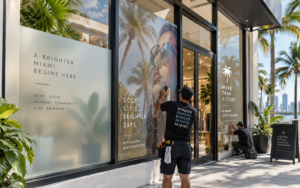
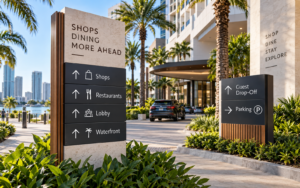
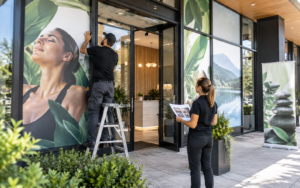
Professional printing and signage services may include fabric backdrops, adhesive vinyl, counter wraps, floor graphics, rigid panels, directional signs, window decals, brochures, and replacement skins.
Every graphic element should use consistent colors, fonts, image styles, and messaging. Consistency helps elevate brands and produces a more polished experience than a collection of disconnected signs.
What Services Should a Booth Design Company in Miami Provide?
A dependable trade show booth design company should provide more than an attractive rendering. A successful project requires coordination among creative development, artwork preparation, engineering, fabrication, printing, shipping, and event labor.
A booth design company in Miami may offer:
- Concept development
- 3D visualization
- Graphic design
- Artwork preparation
- Structural planning
- Large format production
- Custom fabrication
- Exhibit rentals
- Freight coordination
- On-site supervision
- Installation and dismantle
- Storage and refurbishment
A full-service provider should assign a project manager who serves as the primary point of contact. This reduces the risk of conflicting information, missing files, unapproved changes, and scheduling errors.
An end-to-end production process should also include quality checks before the display leaves the facility. Graphics should be inspected for print quality, dimensions, color consistency, finishing, and hardware compatibility.
Lighting should be tested, components should be labeled, and cases or crates should include clear setup information. When practical, the complete exhibit should be assembled before shipping to confirm that all parts fit together.
Competitive prices are relevant, but the lowest price is not always the best value. A graphic that arrives late, does not fit the hardware, or uses the wrong material can create costs far greater than the original savings.
How Can Your Booth Attract Attention and Generate Better Leads?
To attract attention, begin with a message connected to a real customer problem or desired result. Generic statements such as “quality and service” do not give visitors a compelling reason to stop.
A specific benefit, product innovation, measurable outcome, live demonstration, or exclusive event offer creates more curiosity. The visitor should quickly understand what makes your company relevant.
Use eye-catching visuals with discipline. One powerful image can communicate more effectively than several small photographs. Strategic lighting can improve visibility and make products easier to examine.
A clear call to action should guide visitors toward the next step. Examples include:
- Request a live demonstration
- Scan to access a technical guide
- Schedule a consultation
- Enter a giveaway
- Receive a product sample
- Calculate potential savings
- Speak with a specialist
Your booth staff should also understand how the visual presentation supports the sales conversation. Graphics can introduce the topic, but trained representatives must qualify visitors, answer questions, and record useful lead information.
The objective is not simply to create an eye catching tradeshow space. The booth must support interaction, lead generation, and follow-up after the event.
When the structure, graphic system, offer, and team work together, the exhibit can create a lasting impression and deliver measurable value.
How Do You Choose the Right Partner for Booths in Miami?
When comparing providers for booths in Miami, look for a company that understands both creative design and the operational demands of live events.
Local familiarity can be valuable when coordinating delivery windows, venue access, emergency production, or onsite assistance. A provider experienced with Miami trade events should be prepared to discuss logistics, not only visual appearance.
Ask prospective suppliers whether they provide:
- Professional design services
- Print-ready artwork review
- Portable and custom booths
- Replacement graphics
- Rental structures
- Fabric and rigid displays
- Backlit graphics
- Delivery coordination
- Installation support
- Quality control
- Storage options
Request examples of previous projects, including custom structures, portable displays in Miami, fabric graphics, and modular systems. Confirm that the company uses quality products and provides clear production specifications.
A dependable partner will ask detailed questions before recommending a solution. They should understand your audience, campaign objectives, booth dimensions, venue, budget, deadline, transportation plan, and potential reuse.
That consultative process leads to better results than choosing a package based solely on a photograph or advertised price.
Key Things to Remember Before Your Next Trade Show
- Begin planning early and confirm venue requirements before starting production.
- Use one clear message that visitors can understand from the aisle.
- Choose a display system based on booth size, travel frequency, and reuse.
- Use vector logos and sufficiently high-resolution images.
- Keep essential information away from seams, hardware, counters, and low areas.
- Coordinate graphics, furniture, lighting, flooring, and staff presentation.
- Review freight, labor, installation, storage, and dismantle requirements.
- Consider exhibit rentals when flexibility is more important than ownership.
- Work with a provider that can manage design, production, logistics, and onsite support.
- Test QR codes, screens, lighting, and interactive elements before the event.
- Evaluate results through qualified conversations, leads, appointments, and sales opportunities.
- Invest in a professional trade show exhibit that communicates clearly and represents the value of your business.